2.4 Sequences
Sequences
Sequences assign the numbers of documents, transactions and master data of all modules.
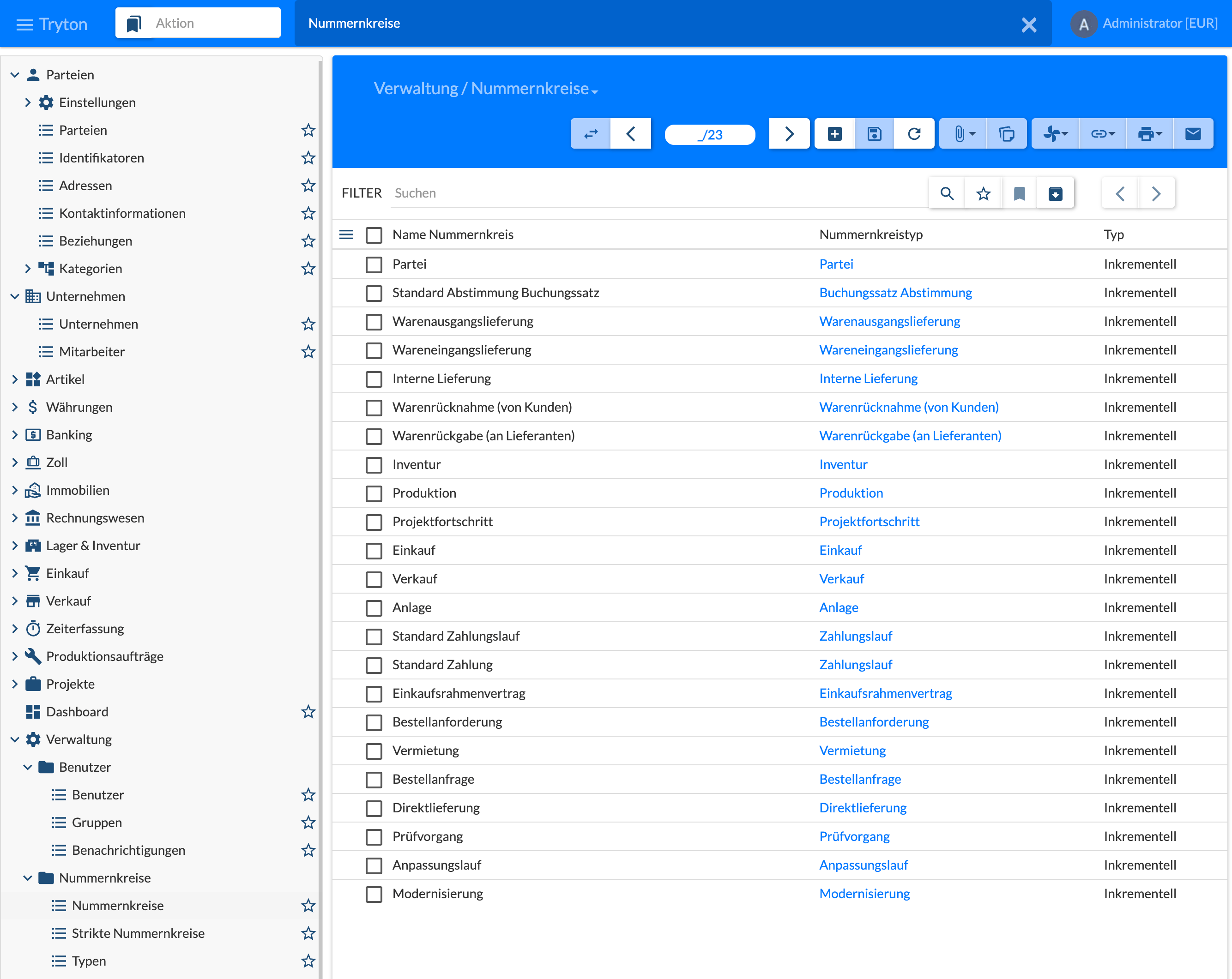
Normal sequences are under Verwaltung › Nummernkreise › Nummernkreise (Administration › Sequences › Sequences). Besides those of the Tryton modules (party, shipments, purchase, sale, payment group etc.) the real estate module ships and sets up its own sequences:
| Sequence | Prefix | Example |
|---|---|---|
| Anpassungslauf (adjustment run) | AL-${year}- | AL-2026-0001, see 6.7 Rent Adjustments |
| Modernisierung (modernisation) | MOD-${year}- | MOD-2026-0001, see 6.7.4 Modernisation |
| Prüfvorgang (inspection) | PR-${year}- | PR-2026-0001, see 8.2 Performing Inspections |
${year} is replaced by the current year, the running number has four digits with leading zeros. Prefix and padding can be adapted if required.
Strict Sequences
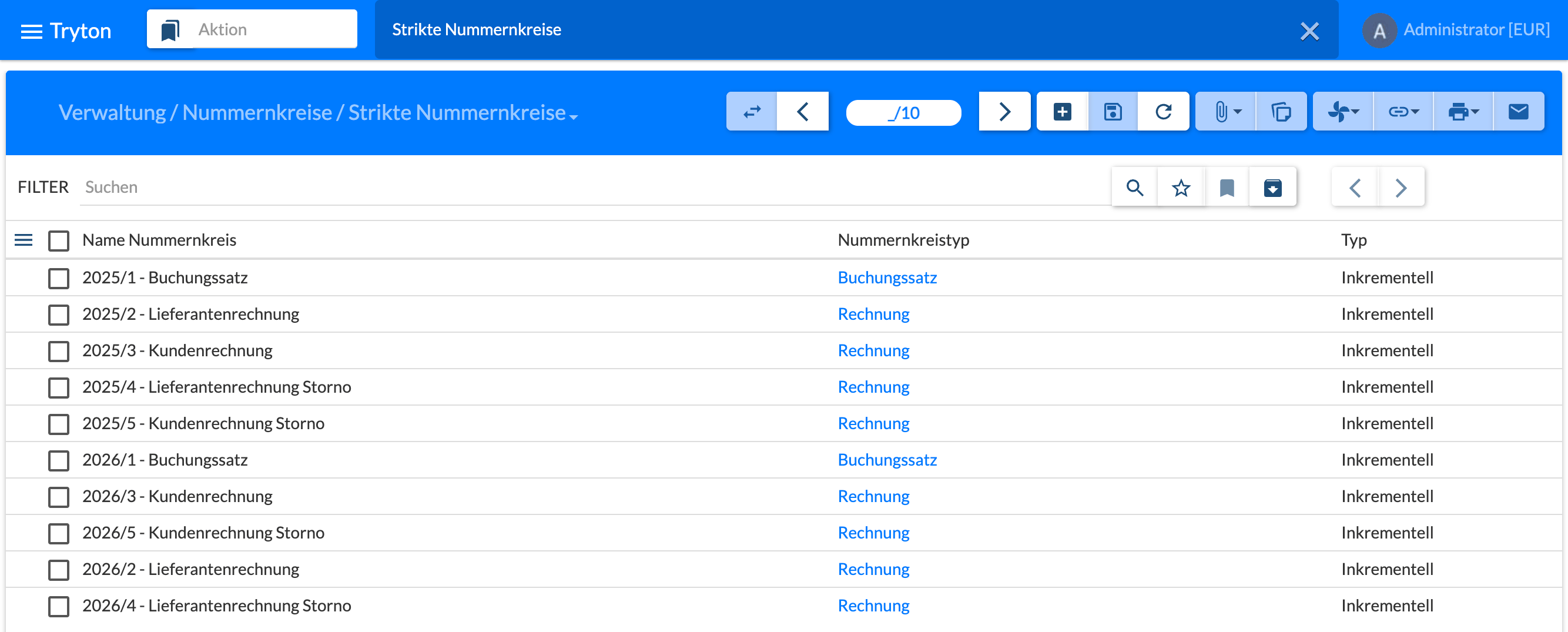
Accounting needs strict sequences (Strikte Nummernkreise): they assign consecutive numbers without gaps, as required for account moves and invoices. They are under Verwaltung › Nummernkreise › Strikte Nummernkreise (Administration › Sequences › Strict Sequences); normal sequences under Nummernkreise, the kinds under Typen (types).
Typically there is one strict sequence per fiscal year for:
| Sequence | Sequence type |
|---|---|
| Buchungssatz (account move) | Buchungssatz |
| Lieferantenrechnung (supplier invoice) | Rechnung (invoice) |
| Kundenrechnung (customer invoice) | Rechnung |
| Lieferantenrechnung Storno (supplier credit note) | Rechnung |
| Kundenrechnung Storno (customer credit note) | Rechnung |
In the figure the names carry the fiscal year and a running number (2025/1 … 2025/5, 2026/1 … 2026/5), all of type Inkrementell (incremental). The name must contain the full name of the fiscal year (e.g. “2025”, not “25”): with Jahresübernahme (renew fiscal year) Tryton copies the sequences and replaces the name of the previous year in the name with that of the following year – “2025/1 - Buchungssatz” thus automatically becomes “2026/1 - Buchungssatz”. The prefix is not adapted, see 4.5 Year-End Closing.
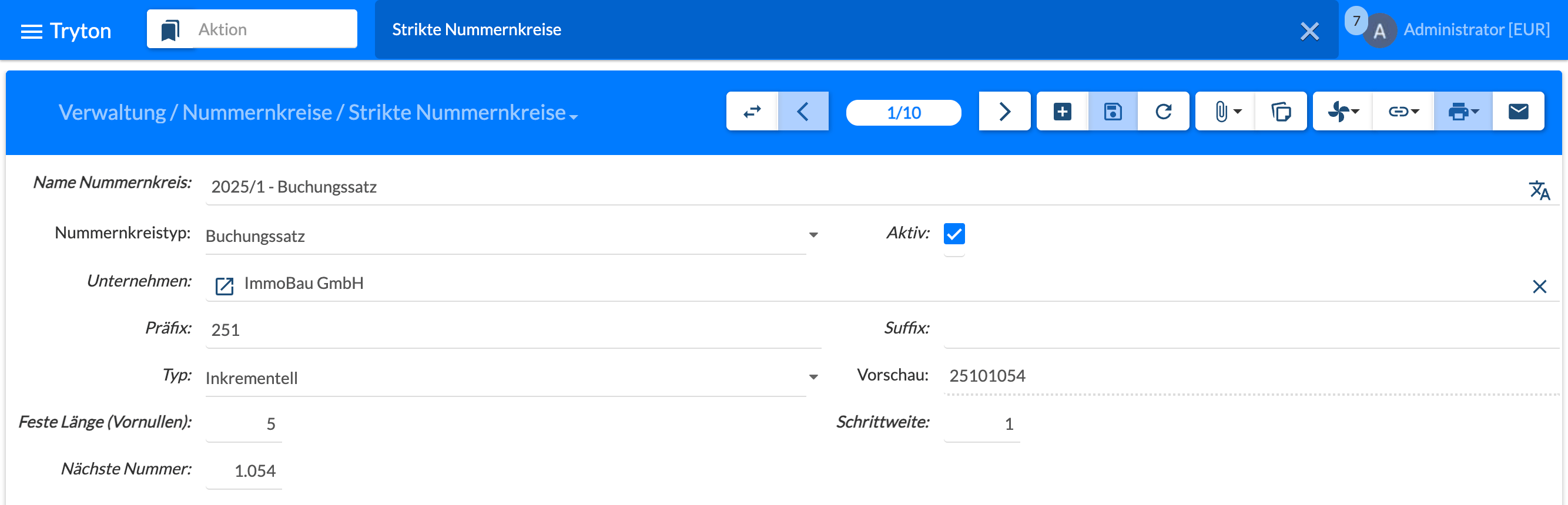
A strict sequence has:
- Name Nummernkreis (name) and Nummernkreistyp (sequence type, e.g. Buchungssatz or Rechnung), Aktiv. The name is translatable (icon on the right of the field), see the note below;
- Unternehmen (company): every sequence is assigned to a company; with several companies each has its own sequences;
- Präfix and Suffix (prefix, suffix), e.g. prefix 251 for year 25, sequence 1;
- Typ (incremental), Feste Länge (Vornullen) (padding), Schrittweite (increment) and Nächste Nummer (next number);
- Vorschau (preview) of the next number from prefix and number, in the figure 25101054 (prefix 251, number 1054 with five digits).
The Name Nummernkreis is stored per language. The translation icon on the right of the field opens the list of languages; after the setup it often still holds English or older names without fiscal year. Jahresübernahme (renew fiscal year) replaces the fiscal year in each language separately. The name must therefore contain the full name of the fiscal year in every language, e.g. German “2025/1 - Buchungssatz” and English “2025/1 - Account Move”. Otherwise the sequence of the following year gets the old name again in that language.
The strict sequences for accounting are assigned in the fiscal year, see 2.5.1 Accounting.