Subsections of 6 Contracts
6.7 Rent Adjustments
A rent adjustment changes exactly one term of a contract by a specific procedure. This page describes what applies to all procedures; the individual procedures are on the sub-pages.
Procedures
| Procedure | Legal basis | Process |
|---|---|---|
| 6.7.1 Graduated Rent | § 557a BGB | All steps are generated as terms of their own when the contract is concluded. |
| 6.7.2 Index Rent | § 557b BGB | Agreement on the contract; every increase by adjustment run with declaration, receipt and execution. |
| 6.7.3 Comparative Rent | §§ 558–558b BGB | Adjustment run based on the rent survey calculations, with cap and consent of the tenant. |
| 6.7.4 Modernisation | §§ 555b–559e BGB | Measure with costs and announcement; increase by adjustment run. |
| 6.7.5 Operating Costs and Free Adjustment | § 560 BGB | Adjustment of prepayments and flat rates; free adjustment. |
Permission
A procedure is only possible if it is entered under Zulässige Anpassungsverfahren (Allowed Adjustment Procedures) on the contract type, on the term type and for the type of use of at least one rental object of the contract item, see 2.5.4 Contracts. In the default data the type of use apartment allows all procedures; office, shop, warehouse, parking space and garage all except comparative rent and modernisation – the comparative rent (§ 558 BGB) exists only for apartments. At most one agreed procedure per term is possible, i.e. graduated or index rent.
Menus
Under Immobilien › Verträge › Mietanpassungen (Real Estate › Contracts › Rent Adjustments), in the order of the work:
| Menu | Content |
|---|---|
| Vereinbarungen (Agreements) | The rent adjustments of all procedures. |
| Indexmieten - Wiedervorlage (Index Rents – Follow-up) | Active index rents with the tabs Due, Next 3 Months and All, see 6.7.2. |
| Anpassungsläufe (Adjustment Runs) | The central entry for index rent, comparative rent and modernisation, see below. |
| Anpassungen (Adjustments) | All adjustments, see below. |
| Mietspiegel-Berechnungen (Comparative Rent Calculations) | Calculations of the comparative rent, see 6.7.3. |
| Modernisierungen (Modernisations) | Modernisation measures, see 6.7.4. |
All lists have the selection Gesellschaft (company, required) and Wirtschaftseinheit (property, optional) at the top. The settings – price indices, import index values, index rent cap rules, modernisation rules – are under Immobilien › Einstellungen.
Tab Mietanpassungen on the Contract
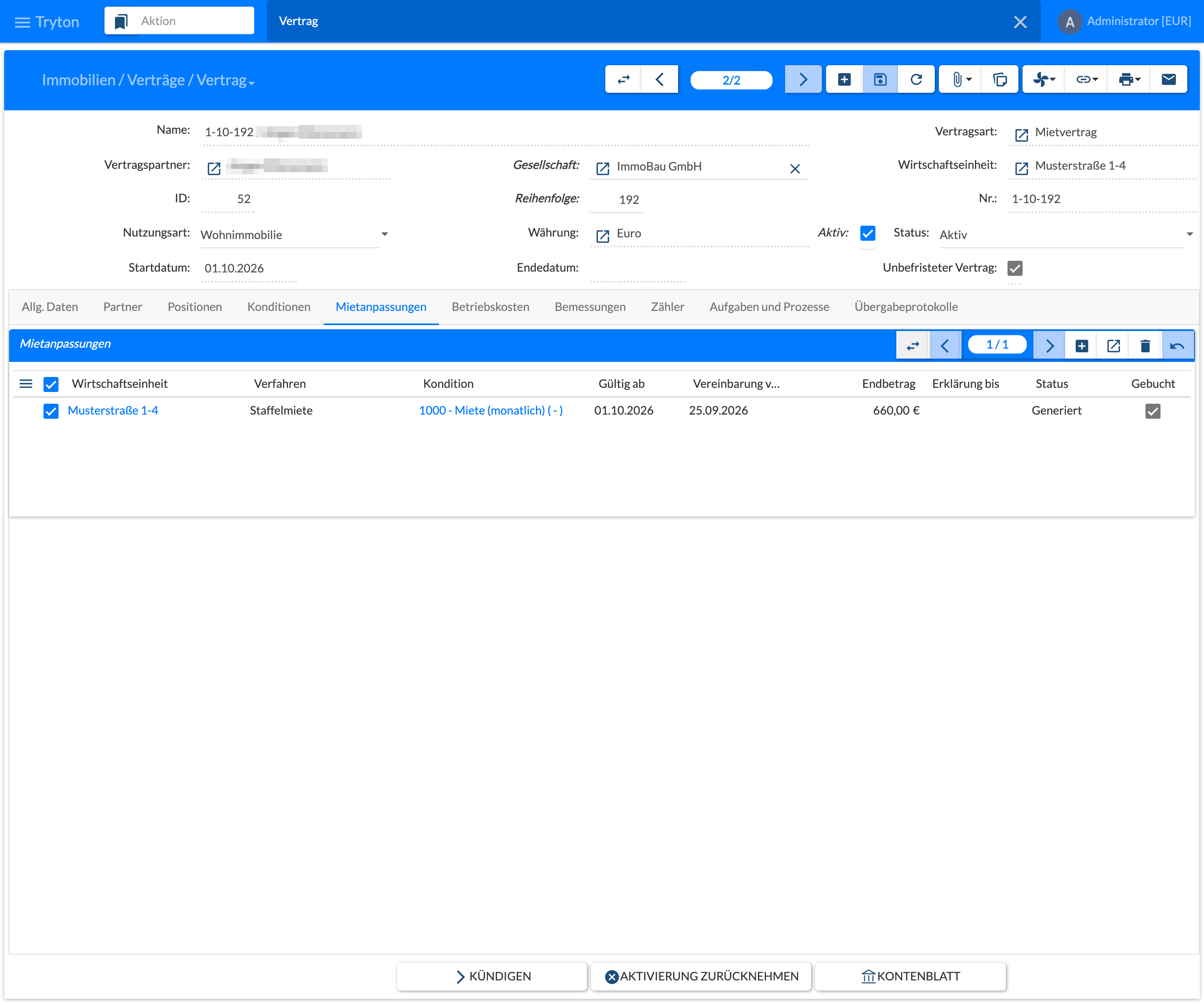
The tab Mietanpassungen (Rent Adjustments) of the contract lists all rent adjustments with property, procedure, term, Gültig ab (valid from), Vereinbarung vom (agreement date), Endbetrag (final amount; for graduated rent the amount of the last step), Erklärung bis (declaration until; for index rent the latest dispatch date of the declaration), Status and Gebucht (booked: at least one step has already been posted). + creates a new rent adjustment, a double click opens it. Header and tabs of the rent adjustment depend on the procedure.
Adjustment Run
Index rent, comparative rent and modernisation are carried out by an adjustment run: menu Verträge › Mietanpassungen › Anpassungsläufe, New, choose the procedure. A run (number AL-year-no.) has procedure, company, optionally properties and contracts as filter, key date, planned declaration date and the parameters of the procedure.
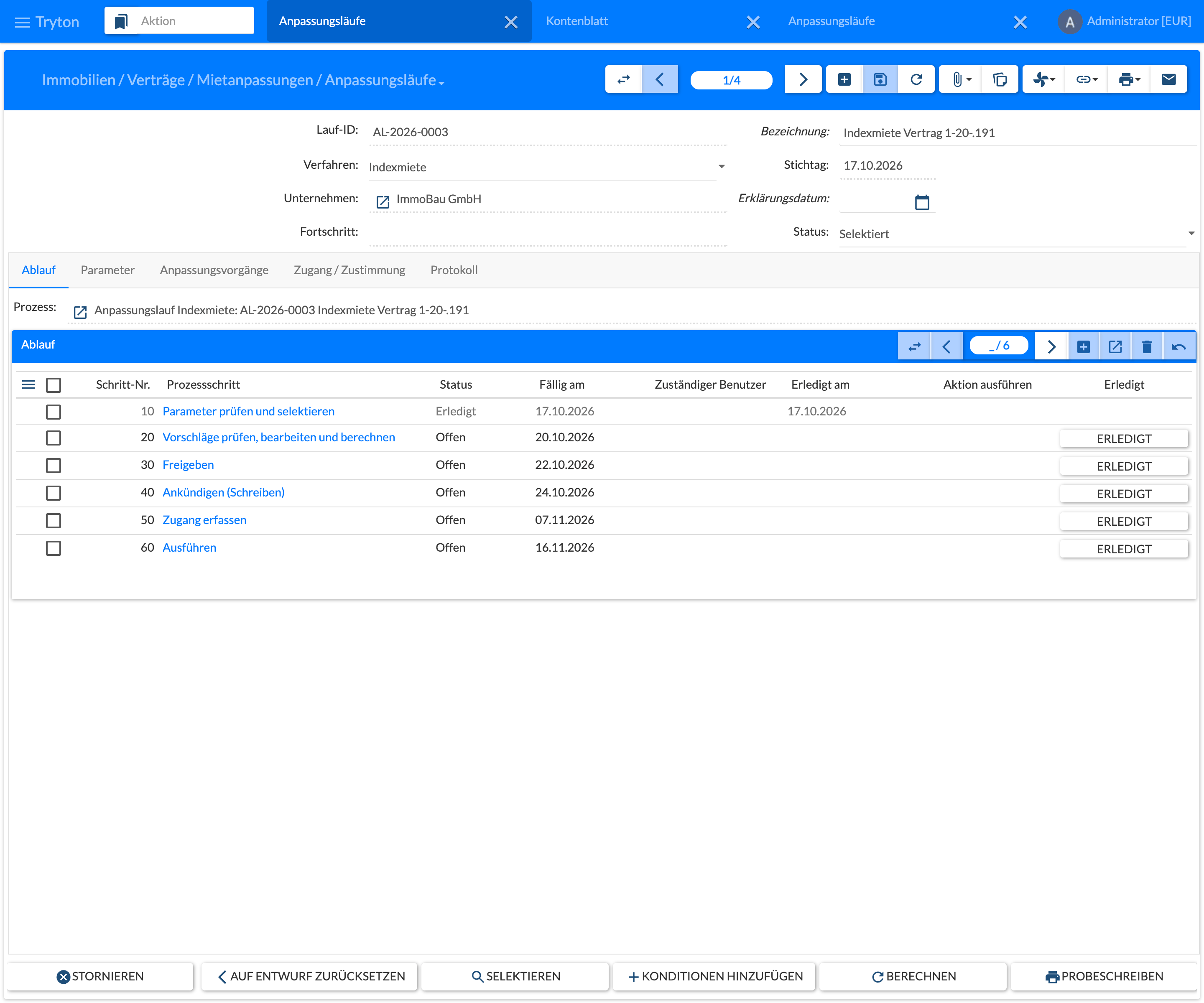
The run has the tabs Ablauf (workflow), Parameter, Anpassungsvorgänge (adjustments), Zugang / Zustimmung (receipts / consents) and Protokoll (protocol); Fortschritt (progress) counts the adjustments per state. The first selection starts the process Anpassungslauf Indexmiete or Vergleichsmiete; the tab Ablauf shows its six steps with due dates – check parameters and select, review, edit and calculate proposals, approve, announce (letters), capture receipts, execute. The steps are completed automatically with the state of the run (in the figure the run is Selektiert, selected, step 10 done).
| Step | Effect |
|---|---|
| Selektieren (Select) | One draft adjustment per matching agreement or term; every candidate gets a protocol line with the result or the reason for skipping. |
| Konditionen hinzufügen (Add Terms) | Add single terms with the checks of the selection. |
| Berechnen (Calculate) | Recalculate values and checks of the adjustments. A manual amount with a reason is possible, but only between the previous and the calculated amount. |
| Freigeben (Approve) | Adjustments without findings are approved, with a warning only with Begründung der Freigabe (approval reason); the others are cancelled. |
| Probeschreiben (Sample Letter) | Shows the letter of one adjustment marked ENTWURF without archiving it. |
| Ankündigen (Announce) | Creates and archives the letters; Schreiben drucken (Print Letters) prints all letters still to be sent in one document. |
| Zugang / Zustimmung | Receipt date, dispatch method and – for the comparative rent – consent per adjustment, or all at once with Zugang erfassen (Capture Receipts). When everything is entered the run is Bereit zur Ausführung (ready). |
| Ausführen (Execute) | Runs in the background: splits the term at the effective date; errors are written to the protocol. Reload the run afterwards. |
| Auf Entwurf zurücksetzen / Stornieren (Reset to Draft / Cancel) | Deletes the drafts resp. cancels the open adjustments and the process. |
Adjustment
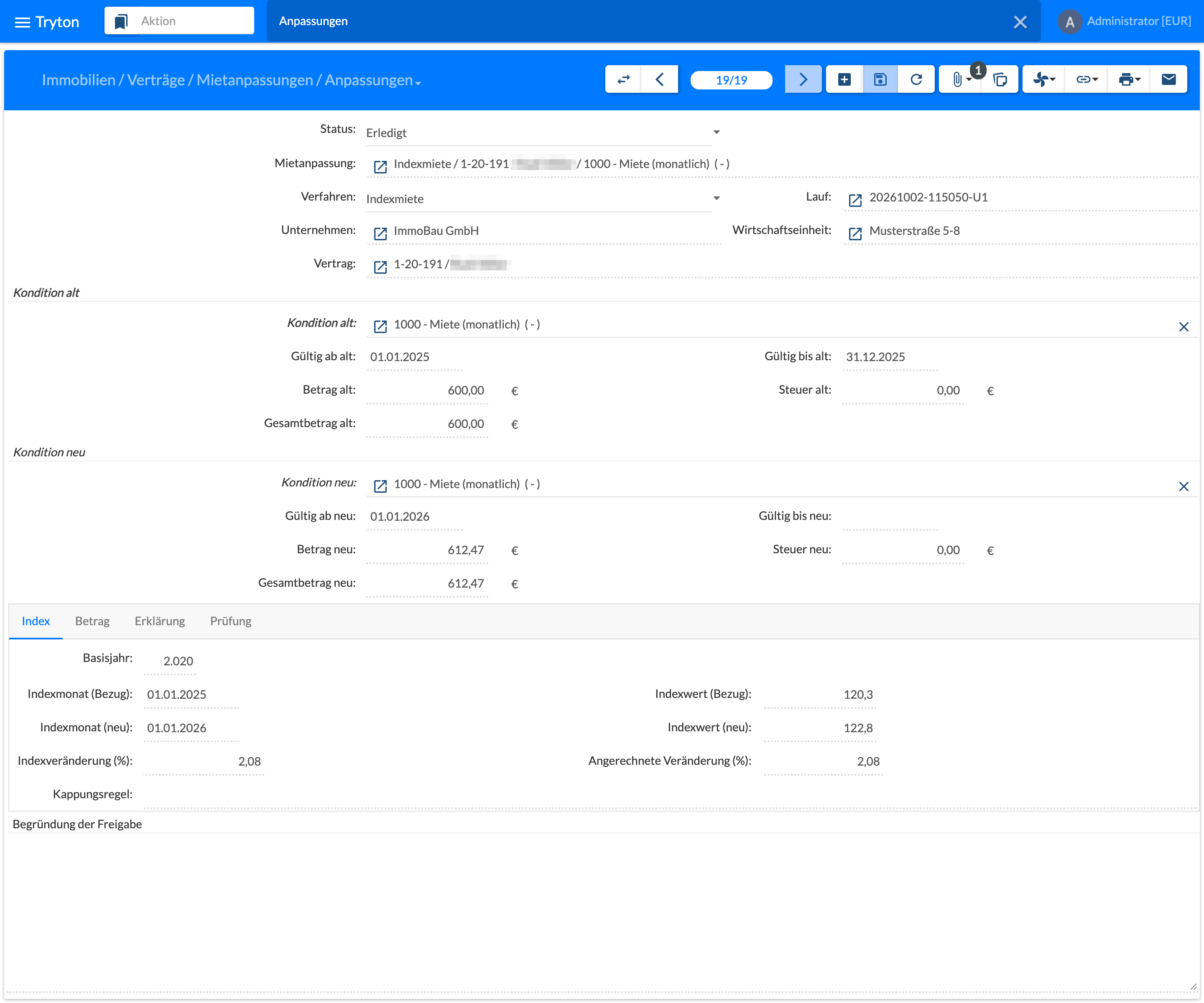
All adjustments are listed in the menu Verträge › Mietanpassungen › Anpassungen (Adjustments); an adjustment can also be opened from the run or on the contract (rent adjustment, tab Anpassungen). It shows the state, the rent adjustment, the run, Kondition alt and Kondition neu (old and new term) with validity and amount, and tabs per procedure – in the figure for the index rent Index, Betrag (amount), Erklärung (declaration) and Prüfung (check protocol). The announced letter is attached to the adjustment (paper clip in the toolbar). The states are Entwurf (draft), Genehmigt (approved), Erklärt (declared), Erledigt (done), Storniert (cancelled) and – for the comparative rent – Abgelehnt (refused).
Subsections of 6.7 Rent Adjustments
6.7.1 Graduated Rent
A graduated rent is agreed and generated once when the contract is concluded. After that nothing needs to be done per step: every step is a contract term of its own, and the periodic posting invoices the new amount automatically from its start.
Prerequisites (once)
- Allow the procedure: Graduated rent must be entered under Zulässige Anpassungsverfahren (Allowed Adjustment Procedures) on the contract type and on the term type of the rent (e.g. 1000 “Apartment rent”). In addition it must be allowed for the type of use of at least one rental object; in the default data this is the case for apartment, office, shop etc. See 2.5.4 Contracts.
- Absolute amount: The term type of the rent must not have a Bemessungstyp (measurement type), otherwise Generieren (Generate) stops with check G15. An Informativer Bemessungstyp (informative measurement type, e.g. living area) is allowed; it is used for the input mode “amount per area” and for the display in €/m².
Create the Contract
- Create the contract as a draft as usual: party, item with rental object, terms. The rent term becomes the reference term (step 0). It starts with the start of the lease; its end usually stays open.
- Optional for residential space: check the initial rent against the rent cap with the wizard Prüfung Vergleichsmiete Neuvermietung (Check Comparative Rent – New Letting).
- Save.
Create and Generate the Steps
The rent adjustment is created in the tab Mietanpassungen of the contract, see 6.7 Rent Adjustments.
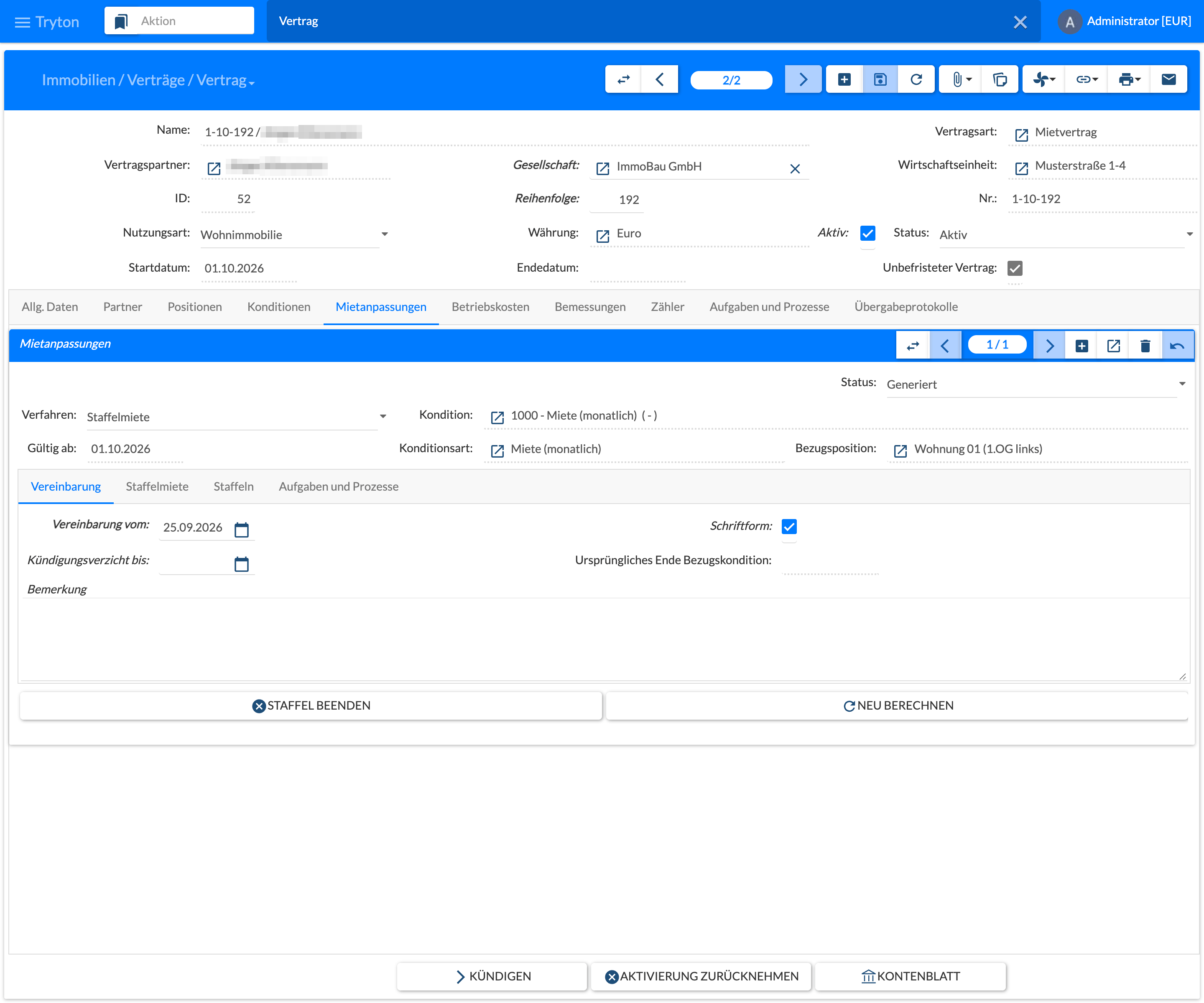
The header of the rent adjustment shows Verfahren (procedure), Kondition (reference term), Gültig ab (valid from), Konditionsart (term type), Bezugsposition (reference item) and the Status (in the figure: Generiert, generated). The tabs Vereinbarung (Agreement), Staffelmiete, Staffeln (Steps) and Aufgaben und Prozesse (Tasks and Processes) structure the data; the field Ursprüngliches Ende Bezugskondition (original end of base term) keeps the end of the reference term before generating – it is restored on reset or taken over by the last step.
- In the tab Mietanpassungen (Rent Adjustments) of the contract click New, choose the procedure Staffelmiete, then the rent term.
- In the tab Vereinbarung (Agreement):
- Vereinbarung vom (agreement date) is required.
- Schriftform (written form) is required for residential space; for commercial space only a warning appears.
- Kündigungsverzicht bis (waiver of termination until) is optional.
- In the tab Staffelmiete:
- Rhythmus (Monate) (interval in months): at least 12.
- Anzahl Staffeln (number of steps).
- Eingabeart Erhöhung (input mode of the increase):
- Absoluter Betrag (absolute amount): € per period;
- Betrag je Fläche (amount per area): € per m²; the area is fixed when generating;
- Prozent (percent), with Bezug %-Erhöhung (basis of the % increase): “Ausgangsbetrag” (initial amount) gives the same increase for every step, “Vorstufe” (previous step) compounds.
- The preview shows all steps with amount, increase and €/m², plus final amount and total increase.
- Click Generieren (Generate). The system runs checks G01–G15 and then creates the steps as terms of their own:
- The reference term ends on the day before the 1st step; every step ends on the day before the next one.
- The last step stays open.
- The cash flows are recalculated; the contract log shows parameters and step overview.
- Activate the contract and print the lease. In the contract letter the later terms – all steps with start and € amount – are listed under § 4. The step table is thus part of the written agreement.
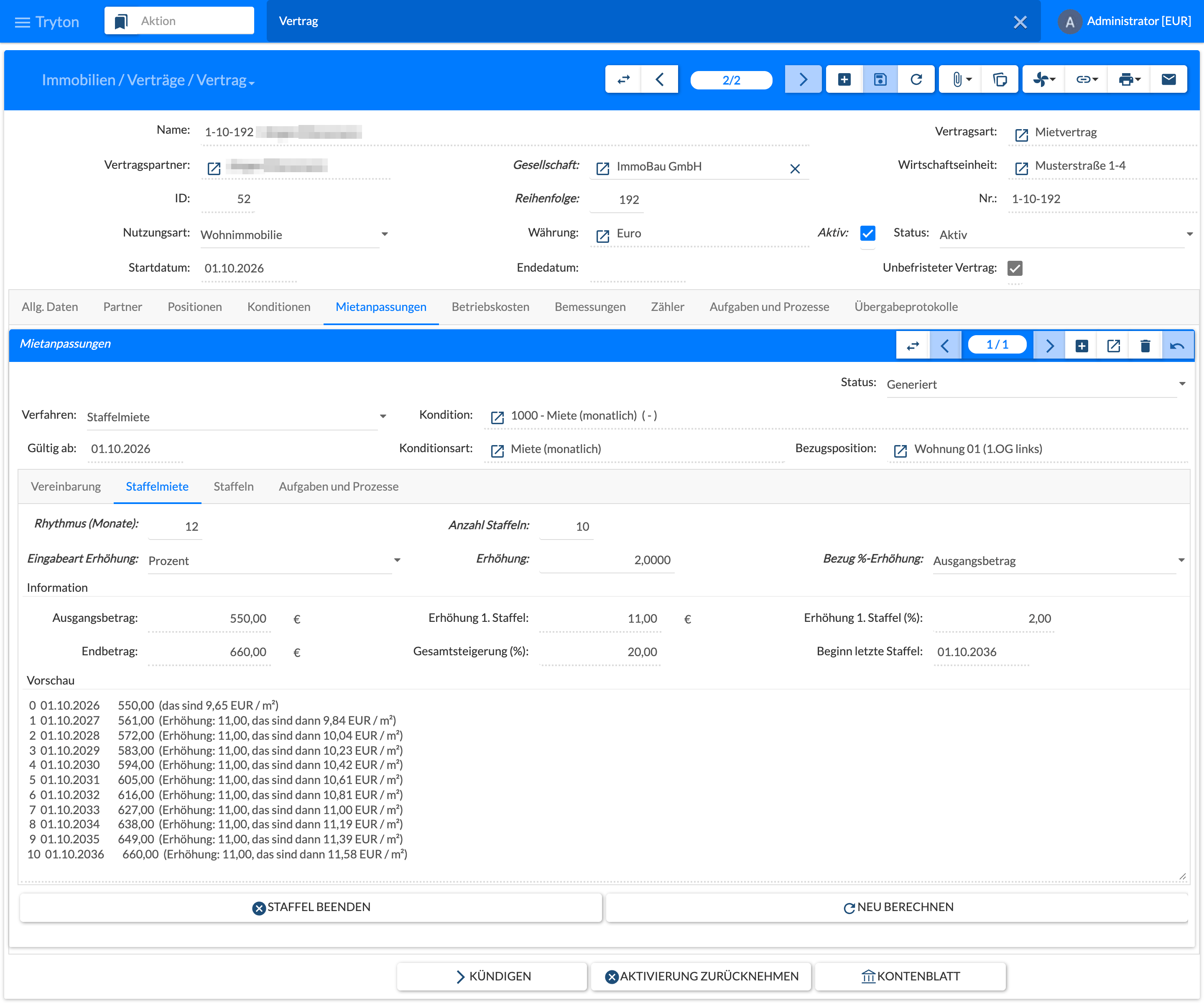
In the example the initial rent of € 550.00 rises every 12 months by 2 % of the initial amount, i.e. by € 11.00 per step. After 10 steps it is € 660.00 from 01.10.2036 (total increase 20 %). The area Information summarises this: Ausgangsbetrag (initial amount), Erhöhung 1. Staffel (increase of the 1st step) in € and %, Endbetrag (final amount), Gesamtsteigerung (%) (total increase) and Beginn letzte Staffel (start of last step). The Vorschau (preview) lists every step with start, amount, increase and €/m² (via the informative measurement type living area).
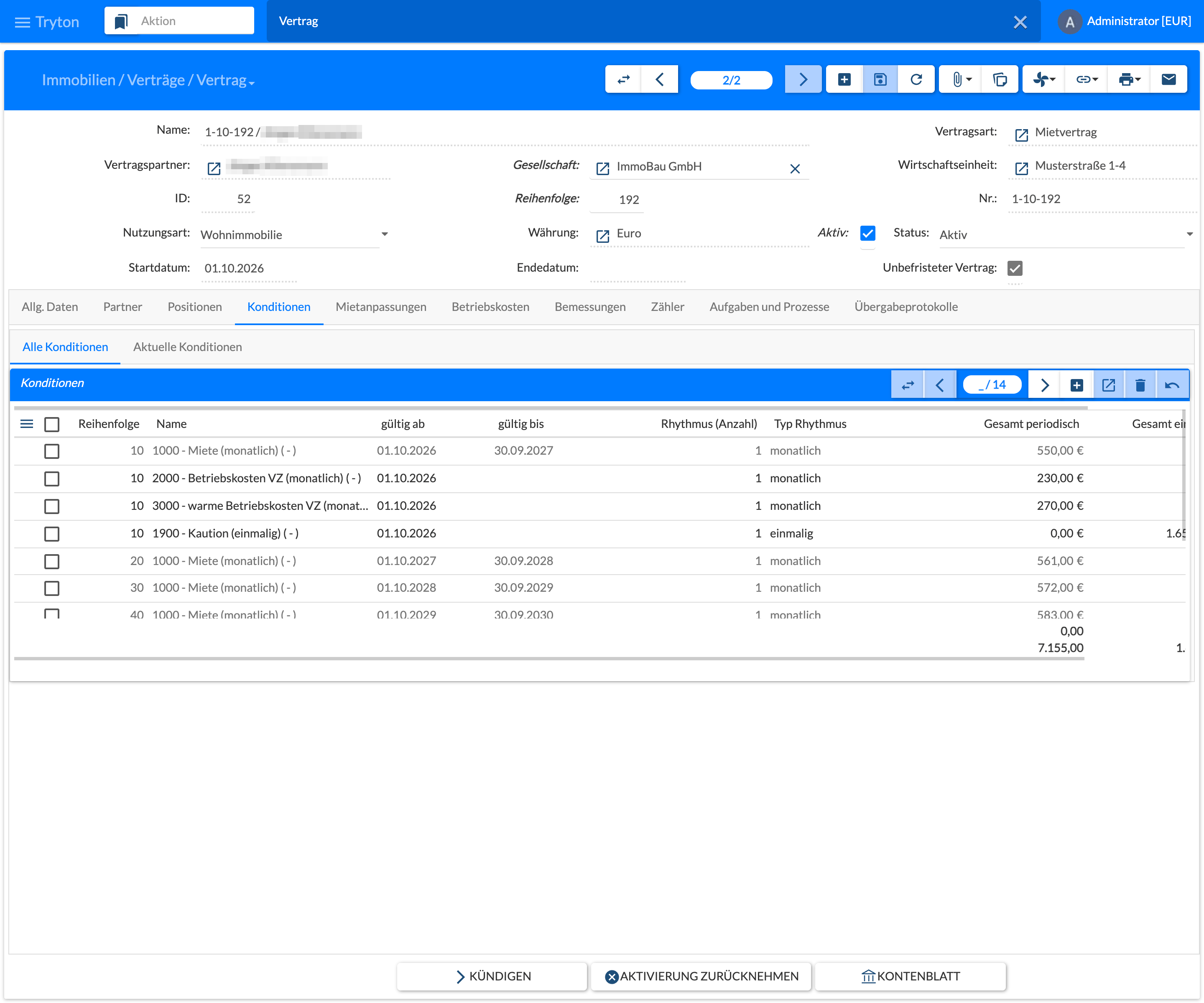
After generating, the steps are listed in the tab Konditionen › Alle Konditionen (Terms › All Terms) of the contract: the reference term (sequence 10, € 550.00) ends on 30.09.2027, the steps follow with sequence 20, 30, 40 … and a term of one year each (€ 561.00, € 572.00, € 583.00 …); the last step stays open. Locked steps are shown in grey. The tab Aktuelle Konditionen (Current Terms) shows only the terms valid today.
As long as no step has been posted, Neu berechnen (Recalculate) and Zurücksetzen (Reset) can be used freely.
Further checks when generating:
- The last step must lie before the end of the contract or term (G07); the message states the maximum possible number.
- The contract must be draft or running and must not have a recorded termination (G09).
- Warning if the step start does not match the rhythm of the debit posting (G13).
- Warning about rounding differences if the quantity ≠ 1 (G12).
Applying the Individual Steps
- No separate step: There is no increase letter, no adjustment run and no consent of the tenant. The periodic posting invoices the amount of a step automatically from its start, see 6.3 Periodic Posting.
- Locked steps: The reference term and all intermediate steps are locked. Start, end, term type, rhythm and taxes cannot be changed, the steps cannot be split, and no other adjustment procedure is possible. Quantity and unit price can be corrected.
- Changes after the first posting: Every change (recalculate, end graduated rent, amount correction) requires a confirmed warning, because a supplement with the tenant is needed. It only affects steps not yet posted and is logged.
- Staffel beenden (End graduated rent): deletes the unposted steps. The last posted step then stays open.
- After the last step: The last step can be adjusted normally again, e.g. by comparative rent in an adjustment run, modernisation or a follow-up graduated rent (new graduated rent with the last step as reference term).
- Follow-ups: The task rules Staffelmiete endet (graduated rent ends, 3 months before the start of the last step) and Kündigungsverzicht endet (waiver of termination ends, 3 months before) exist but are inactive by default. Activate them in 2.5.7 Tasks and Processes if needed.
Legal Framework (§ 557a BGB)
| Rule | Implementation in the module |
|---|---|
| Written agreement (para. 1) | Field Schriftform: error for residential space (G10), note for commercial space. |
| Every rent or increase stated as an amount of money (para. 1) | Every step has exactly one € amount, rounded to the cent. Input per m² or in % is only a calculation aid; the printed € table is decisive. |
| Rent unchanged for at least 1 year (para. 2 sentence 1) | Rhythm ≥ 12 months (G02). |
| No increase under §§ 558–559b during the graduated rent (para. 2 sentence 2) | Steps are locked. Comparative rent (V01), modernisation (E02) and index rent (I14) skip locked steps. Graduated and index rent on the same term exclude each other. Operating costs (§ 560) remain possible. |
| Waiver of termination at most 4 years from the agreement (para. 3) | Warning G11; only the waiver would be invalid. |
| Step takes effect without a declaration | No letter, posting directly from the terms. |
| Rent cap per step at the time it falls due (para. 4) | Not yet implemented. Only the initial rent is checked by the wizard for new lettings; the comparative rent of future dates is not known when the contract is concluded. |
6.7.2 Index Rent
Unlike the graduated rent, an index rent is not generated in advance. Only the agreement is stored in the contract; every later increase is processed as an adjustment run with a letter to the tenant, receipt and execution.
Prerequisites (once)
Allow the procedure: Index rent must be allowed on the contract type, on the term type of the rent (e.g. 1000) and for the type of use of the rental object. The default data allow it for apartment, office, shop etc.
Index series: menu Immobilien › Einstellungen › Preisindizes (Real Estate › Configuration › Price Indices), series VPI-DE (consumer price index Germany, Destatis 61111-0002, base 2020). For residential space only this series is allowed. For commercial space there is also HVPI-DE; it is maintained manually.
Maintain index values, in one of three ways:
- automatically via GENESIS-Online: the buttons Werte abrufen (Fetch Values) or Ab Basisjahr abrufen (Fetch from Base Year) on the series, or as the job
price_index_import, e.g. on the 20th of every month because Destatis publishes in the middle of the following month (see 2.6 Jobs and Periodic Tasks). For this the administrator must enter the access keygenesis_tokenintrytond.conf; - by CSV file with Immobilien › Einstellungen › Indexwerte importieren (Import Index Values; also a download from GENESIS-Online);
- manually in the value list of the series.
Only final values of the current base year count. Values already used by an announced or executed adjustment can no longer be changed.
- automatically via GENESIS-Online: the buttons Werte abrufen (Fetch Values) or Ab Basisjahr abrufen (Fetch from Base Year) on the series, or as the job
Create Contract and Agreement
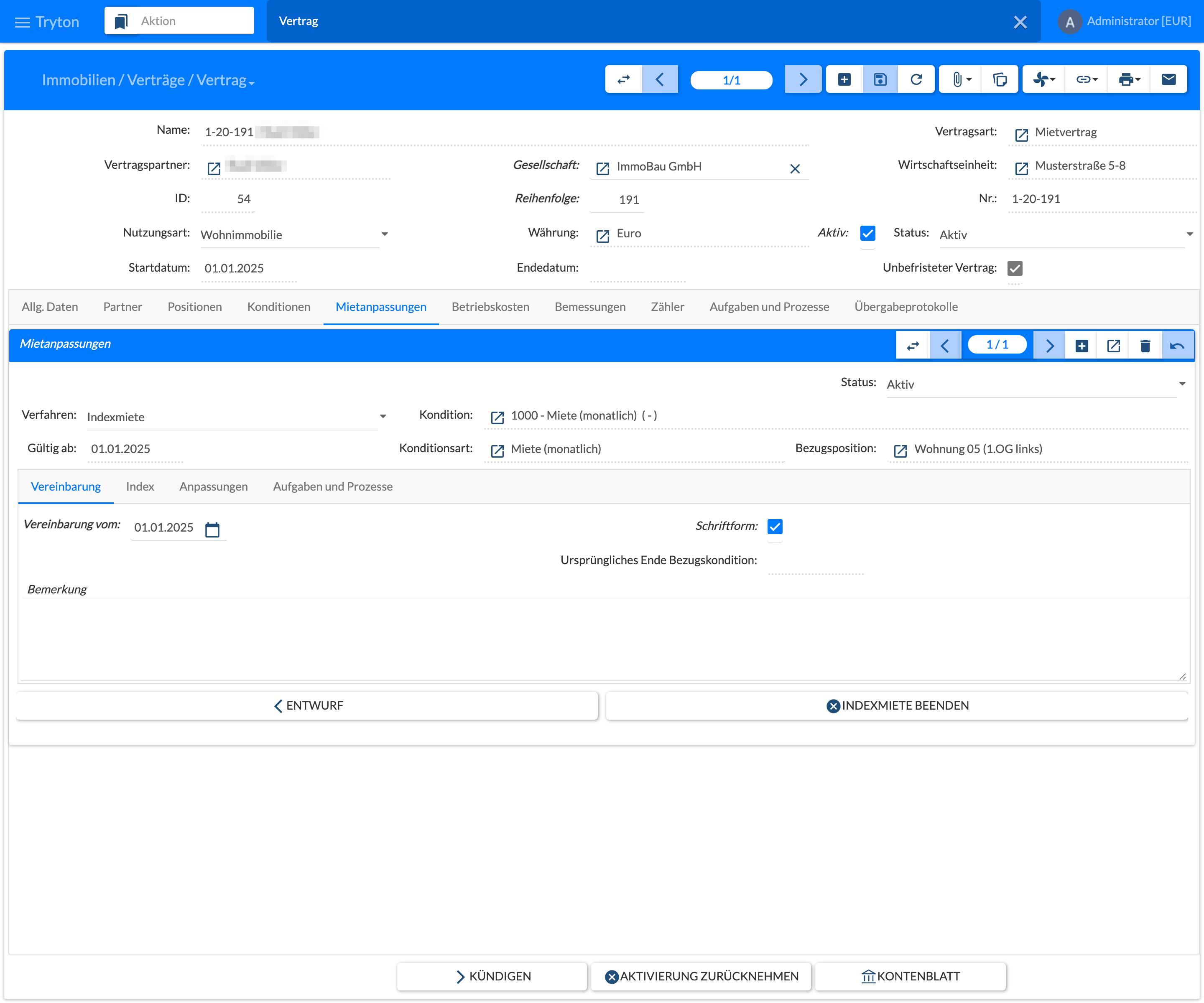
The index rent has the tabs Vereinbarung (Agreement), Index, Anpassungen (Adjustments: the adjustments from the adjustment runs) and Aufgaben und Prozesse (Tasks and Processes). In the figure the agreement is active; Entwurf (Draft) resets it (no longer possible once an adjustment is approved, announced or executed), Indexmiete beenden (Close Index Rent) closes it.
- Create the contract with the rent term as an absolute amount as usual. Optionally, for residential space, check the initial rent with Prüfung Vergleichsmiete Neuvermietung (rent cap).
- In the tab Mietanpassungen (Rent Adjustments) click New, choose the procedure Indexmiete, then the rent term.
- In the tab Vereinbarung (Agreement): enter Vereinbarung vom (agreement date) and Schriftform (written form); both are required for residential space.
- In the tab Index:
- Preisindex (price index): VPI-DE.
- Ausgangsmonat (base month): the index month stated in the contract. Ausgangswert (Vertrag) and Basisjahr (Vertrag) (value and base year stated in the contract) are for documentation only; the decisive Ausgangswert (base value) is read from the current series.
- Schwelle (threshold): none, percent or index points, e.g. “only from 5 %”.
- Wirksamkeitsregel (effective rule): statutory for residential space (required); for commercial space also contract month with an offset in months.
- Kappung anwenden (apply cap): automatic or never.
- Click Aktivieren (Activate). The system checks:
- written form and agreement date (I01);
- VPI for residential space (I02);
- a value for the base month (I03);
- no comparative rent on the term; for a modernisation only a warning appears (I10);
- for commercial space a note on the Preisklauselgesetz (I12).
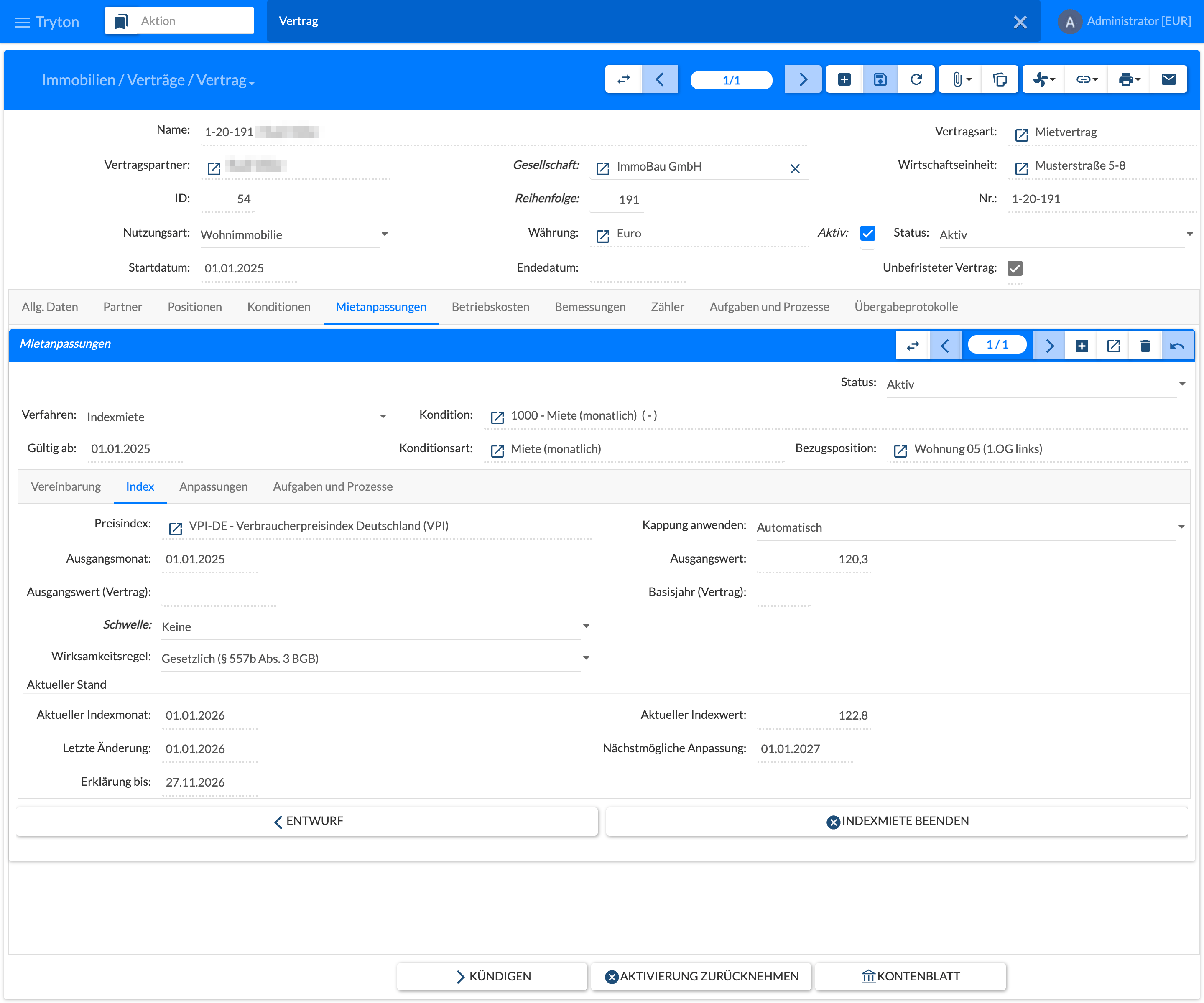
Afterwards the tab shows in the area Aktueller Stand (current status) the current index month and value, the last change, the next possible adjustment (+12 months) and Erklärung bis (declaration until) – the latest dispatch date for the increase to take effect on the next possible date.
Indexmiete beenden (Close Index Rent) closes the agreement, e.g. for a supplement. Afterwards another procedure is possible for the term again.
Ongoing: Increase by Adjustment Run
Overview: menu Verträge › Mietanpassungen › Indexmieten - Wiedervorlage (Contracts › Rent Adjustments › Index Rents – Follow-up) with the tabs Fällig (due), Nächste 3 Monate (next 3 months) and Alle (all). The task rule Indexanpassung vorbereiten (Prepare index rent adjustment) creates a task 14 days before Erklärung bis; the rule Indexwerte veraltet (Index values outdated) reports when a series has no current values. Both are activated in 2.5.7 Tasks and Processes.
Procedure: menu Verträge › Mietanpassungen › Anpassungsläufe (Adjustment Runs), New, procedure Indexmiete.
Parameters:
- company, optionally properties or contracts;
- key date;
- series;
- index month: the last final value is proposed;
- planned declaration date;
- Senkungen einbeziehen (include decreases): off by default; decreases then only appear in the protocol.
Selektieren (Select):
- One adjustment is created per active agreement. An agreement is skipped if an adjustment is already open (I07), the lock period has not been reached (I04) or the threshold is missed.
- The adjustment contains reference value → new value, change in % and points, the new amount (old amount × index ratio, rounded to the cent) and the planned effective date.
- Every check is recorded in the check protocol; the protocol of the run states the result or the reason for skipping for every agreement.
Berechnen (Calculate): optional, after corrections. If necessary, enter a manual amount with a reason.
Freigeben (Approve): adjustments with errors are cancelled. Warnings require an approval reason.
Optionally Probeschreiben (Sample Letter), then Ankündigen (Announce): one declaration is created per adjustment (report
index_adjustment_letter_de.odt). It is addressed to all main tenants and contains index series and base year, old and new index month and value, the change in % and points, old and new net rent, the difference and the expected effective date. The original is archived on the adjustment and on the contract; the values are frozen from then on.Dispatch and receipt: in the tab Zugang / Zustimmung (Receipts / Consents) enter the receipt date and dispatch method per adjustment, or all at once with Zugang erfassen (Capture Receipts). The effective date is calculated from it: the 1st of the month after next following receipt. When all receipts are entered, the run is Bereit zur Ausführung (ready).
Ausführen (Execute): the system checks again
- lock period (I04), running contract and termination (I06), no posting beyond the effective date (I09), no graduated rent lock (I14);
- the cap at the actual receipt (I11).
It then splits the term at the effective date with the new price, recalculates the cash flows and writes the contract log. From then on the periodic posting invoices the new amount. The next adjustment refers to this index value.
The structure of adjustment run and adjustment is described in 6.7 Rent Adjustments.
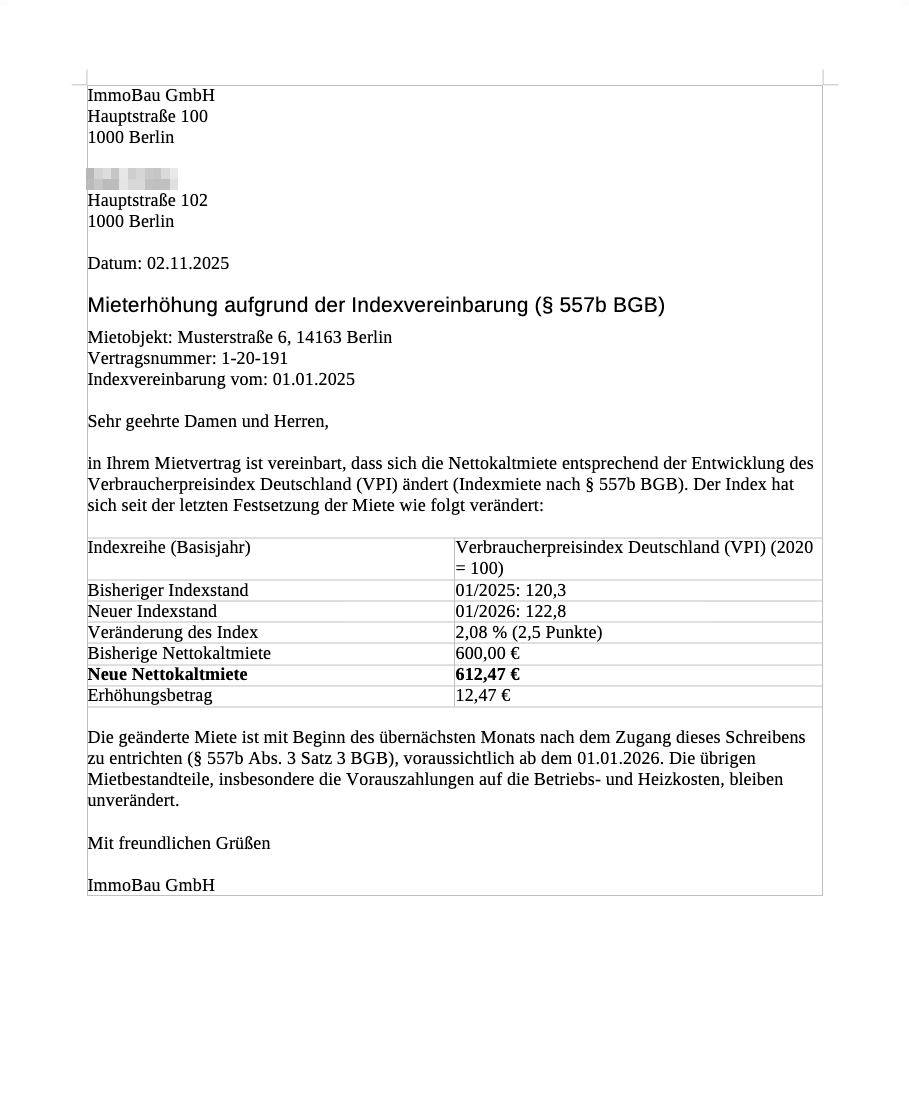
The letter created by Ankündigen (Announce) states rental object, contract number and date of the index agreement and shows in a table the index series with base year, previous and new index level, the change in % and points, previous and new net rent and the increase. It points out that the new rent applies from the start of the month after next following receipt (§ 557b para. 3 sentence 3 BGB) and that the prepayments remain unchanged.
In the example of the adjustment (state Erledigt, done) the index rose from 120.3 (01/2025) to 122.8 (01/2026), i.e. by 2.08 %; the rent rose from 01.01.2026 from € 600.00 to € 612.47 (600.00 × 122.8 / 120.3). With a cap rule the counted change (Angerechnete Veränderung) would be lower than the index change.
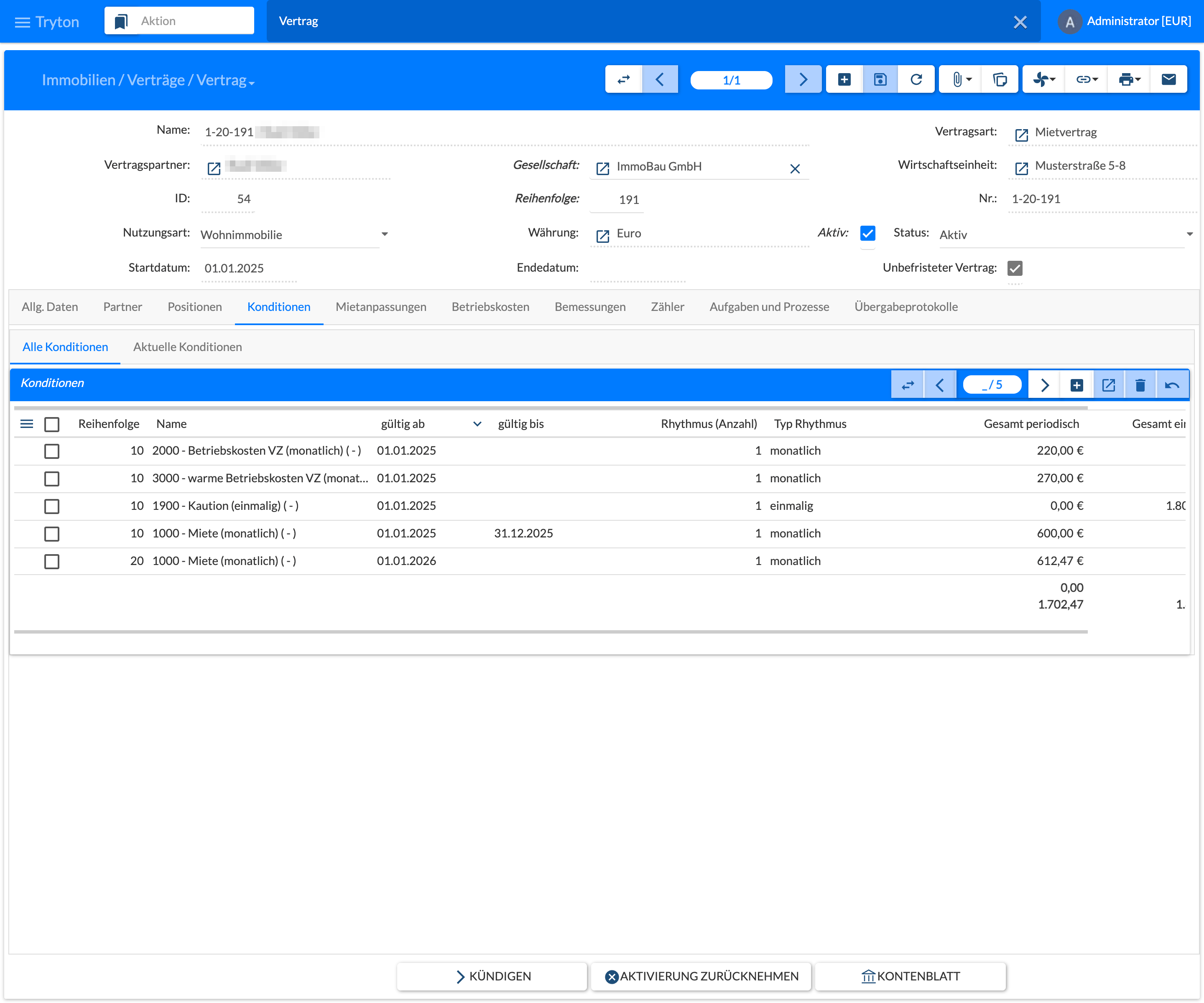
After execution the rent term is split: the previous term (sequence 10, € 600.00) ends on 31.12.2025, the new one (sequence 20, € 612.47) is valid from 01.01.2026 and stays open. The other terms, e.g. operating cost prepayments and deposit, are not affected.
Legal Framework
Residential space – § 557b BGB
| Rule | Implementation in the module |
|---|---|
| Written agreement, tied to the Destatis VPI (para. 1) | Written form required (I01), only series marked “allowed for residential space” (I02). |
| Rent unchanged for at least 1 year each (para. 2 sentence 1) | I04 at selection and execution; next possible date. |
| No increase under § 558 (comparative rent); § 559 only for measures the landlord is not responsible for (para. 2) | Comparative rent locked (I10, error); modernisation only with a warning – whether the measure is permitted must be checked case by case. Graduated and index rent on the same term exclude each other. |
| Declaration in text form with index change and rent or increase as an amount of money (para. 3) | Declaration letter with all details, archived. |
| Effective from the start of the month after next following receipt (para. 3) | Effective date from the receipt date; no execution without receipt. |
| Rent cap only for the initial rent (para. 4) | Wizard Prüfung Vergleichsmiete Neuvermietung on the draft contract; no check for the index adjustments. |
| Deviations to the tenant’s disadvantage are invalid (para. 5) | For residential space the statutory effective rule is required; deviating settings are rejected as errors. |
| Decrease when the index falls | Detected (I13); an adjustment is only created with Senkungen einbeziehen. |
Commercial space – Preisklauselgesetz: § 557b does not apply here. VPI or HVPI clauses are allowed, among others, for long-term contracts (at least 10 years or a corresponding waiver of termination). The module only gives a note (I12); the clause must be checked legally. Written form is only a warning for commercial space, and the effective date can follow the contract month.
Planned, not yet in force – “Mietrecht II”
In a tight housing market, the annual index increase above 3 % is to count only by half. This is prepared as a cap rule that can be switched off (Immobilien › Einstellungen › Kappungsregeln Indexmiete, Index Rent Cap Rules; new rules are inactive). Decisive is the flag Angespannter Wohnungsmarkt (tight housing market) with validity on the property, see 5.1 Property. Once the law is promulgated, the rule must be checked against the legal text.
6.7.3 Comparative Rent
The module justifies a rent increase up to the local comparative rent (§§ 558–558b BGB) exclusively by a rent survey (Mietspiegel) stored in the system. Expert opinions, comparable apartments or a rent database are not supported. The work has three parts: maintain rent survey and master data once, classify the objects, and then carry out an adjustment run per increase.
Master Data (once)
Rent surveys are maintained under Immobilien › Einstellungen › Mietspiegel (Real Estate › Configuration › Rent Surveys; group real estate administration).
Version and Tab Allgemein
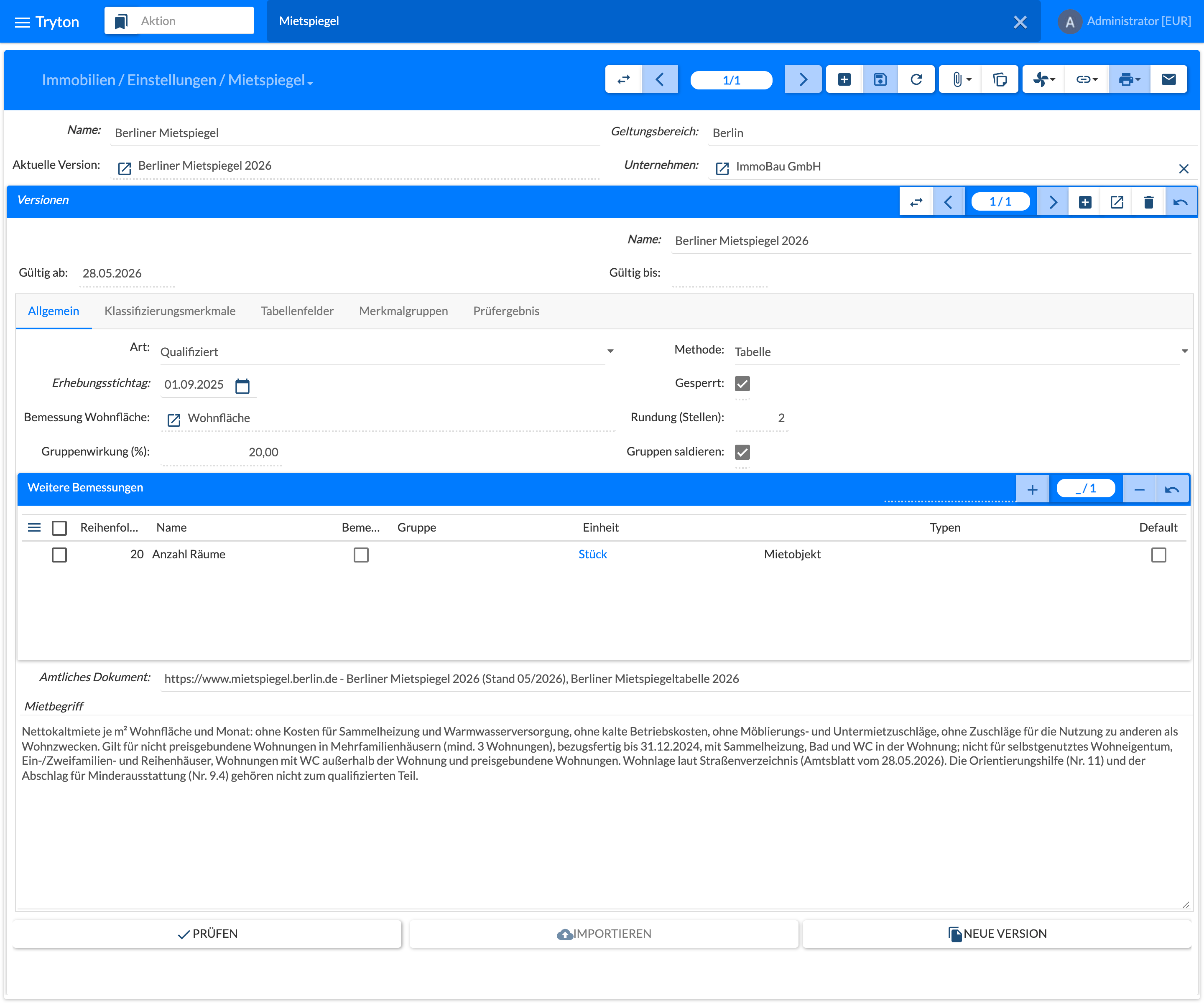
The rent survey has Name, Geltungsbereich (area of validity), Unternehmen (company) and the Aktuelle Version (current version); below are the Versionen (versions) with name, Gültig ab and Gültig bis (valid from / to). Each version has the tabs Allgemein (general), Klassifizierungsmerkmale (classification attributes), Tabellenfelder (table fields), Merkmalgruppen (feature groups) and Prüfergebnis (check result) and the buttons Prüfen (Check), Importieren (Import) and Neue Version (New Version).
In the tab Allgemein of the version:
- Art (kind): simple or qualified;
- Methode (method): table (as in Berlin) or regression;
- Erhebungsstichtag (survey key date);
- Bemessung Wohnfläche (living area measurement, default living area) and, if needed, Weitere Bemessungen (further measurements), e.g. number of rooms;
- Gruppenwirkung (%) (group effect: range share of the feature groups, default 20 %) and Gruppen saldieren (net groups: positive and negative groups offset each other);
- Rundung (Stellen) (rounding, decimals);
- Amtliches Dokument (official document, source) and Mietbegriff (definition of rent: which rent the survey states and what it applies to); the official document itself is attached to the version;
- Gesperrt (locked) shows that accepted calculations use the version; it can then no longer be changed.
Classification Attributes (Klassifizierungsmerkmale)
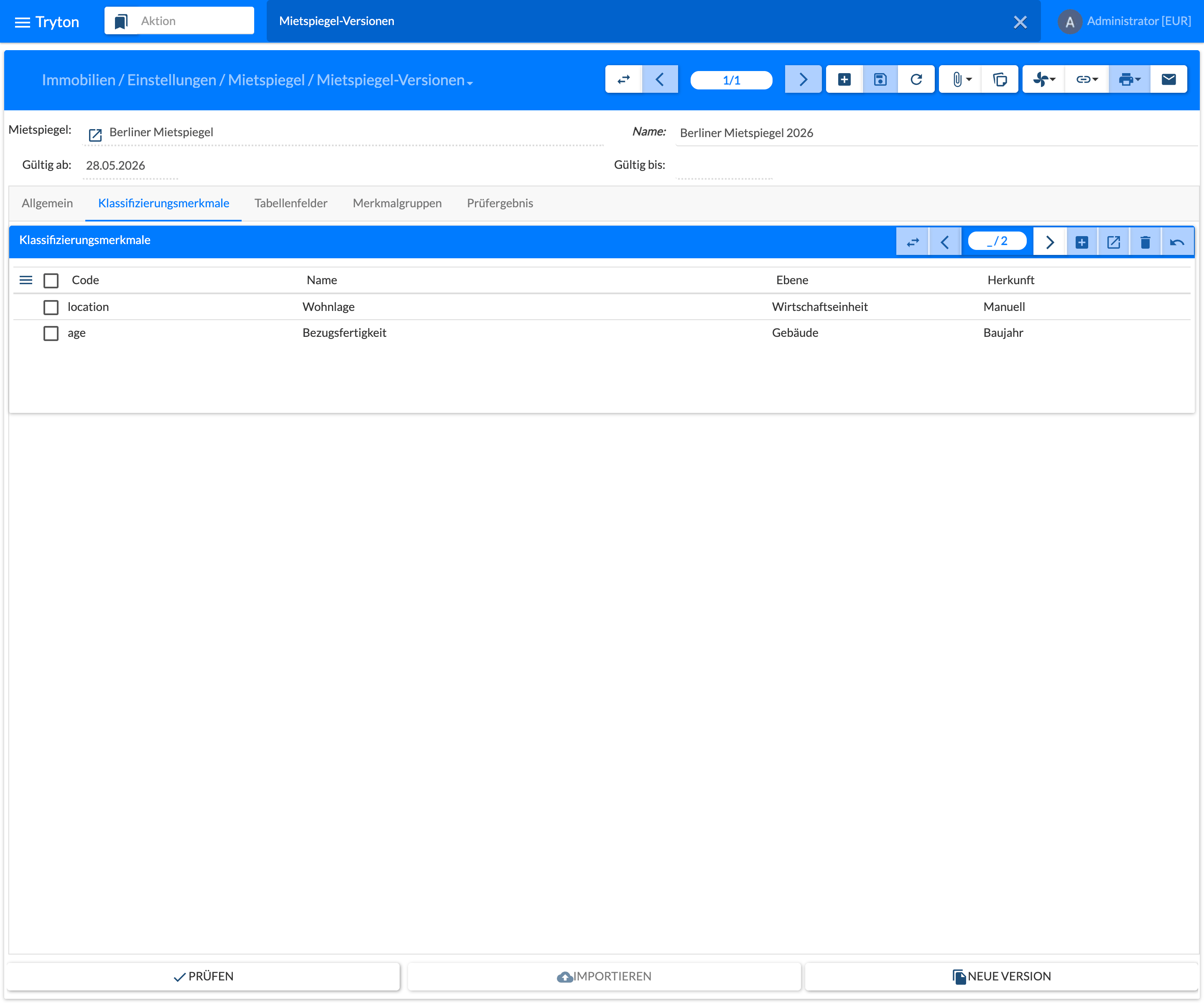
The classification attributes are the table axes with their classes. For each attribute Code, Name, the Ebene (level: property / building / rental object) and the Herkunft (source) are set: manual, year of construction of the building, or measurement with a value range per class. In the Berlin example these are the Wohnlage (residential location; property, manual) and the Bezugsfertigkeit (ready for occupancy; building, from the year of construction).
Table Fields (Tabellenfelder)
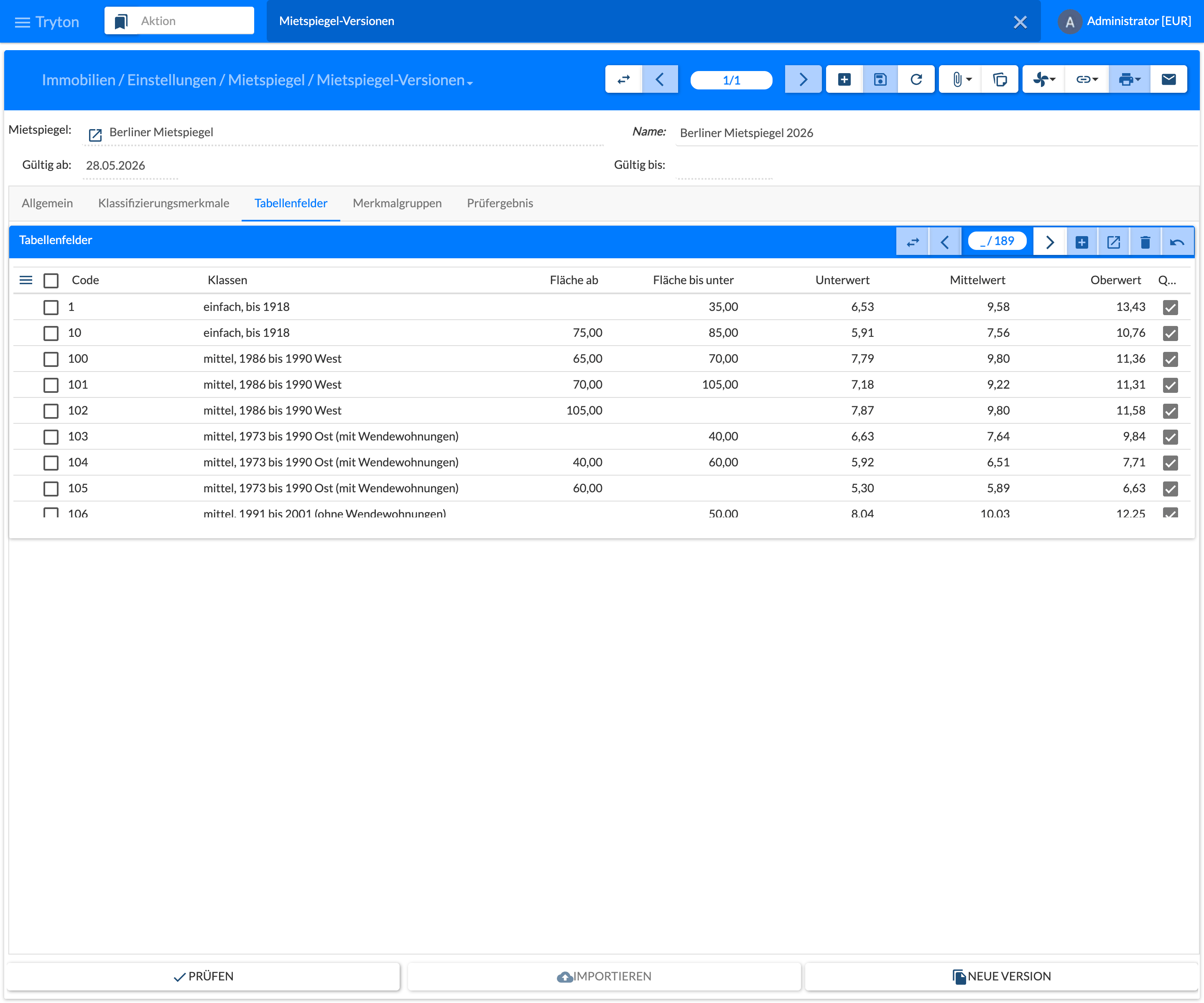
Each table field has a Code, one class per classification attribute (column Klassen, e.g. “mittel, 1986 bis 1990 West”), the area range Fläche ab / Fläche bis unter (area from / up to below; empty = open), Unterwert, Mittelwert and Oberwert (lower, middle and upper value) in €/m² and the flag qualifiziert (qualified). The Berlin rent survey 2026 has 189 table fields. The calculation looks for the field whose classes and area range match the apartment; the starting point is the middle value, and the feature groups shift it within the range.
Feature Groups and Features (Merkmalgruppen)
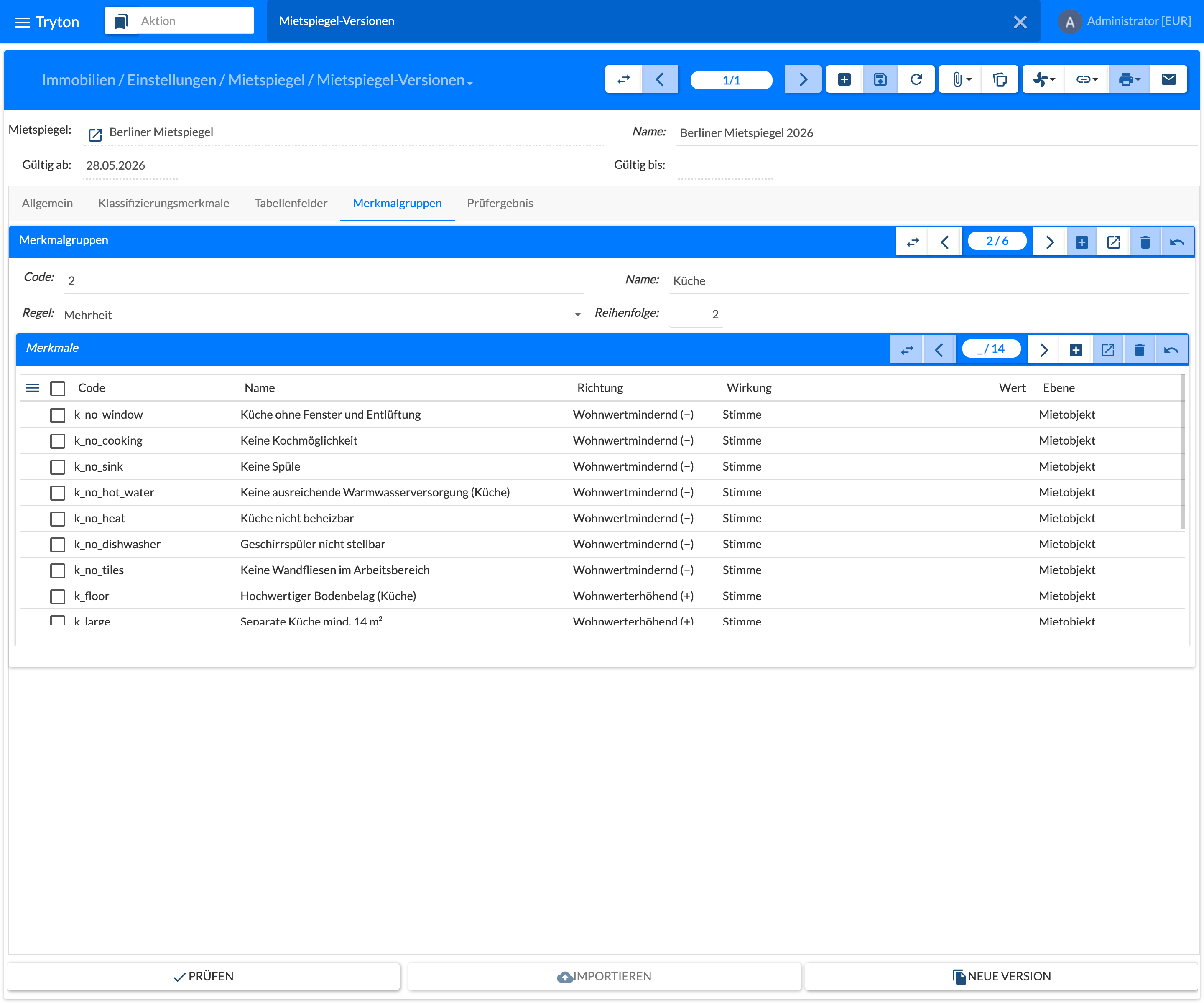
Each feature group has Code, Name, Regel (rule) and Reihenfolge (sequence), and below it its Merkmale (features) with code, name, Richtung (direction: increasing + / decreasing −), Wirkung (effect: a vote for the rule majority, otherwise an amount), Wert (value) and Ebene (level). The figure shows the group Küche (kitchen) of the Berlin rent survey with 14 features, e.g. “Küche ohne Fenster und Entlüftung” (kitchen without window and ventilation, −) or “Hochwertiger Bodenbelag (Küche)” (high-quality flooring, +). For the group:
- rule majority (+1/0/−1) or additive (€/m² or %);
- per feature direction, level and “only for classes” (e.g. only up to year of construction 2001);
- automatic setting by a measurement (e.g. energy consumption value);
- mutual exclusions.
Import, Check, New Version
Table fields and features can be read in with Importieren (Import, CSV) with preview and problem list. Afterwards check consistency with Prüfen (Check); the result is shown in the tab Prüfergebnis. For a new rent survey Neue Version (New Version) copies everything; the codes remain the same and so do the classifications of the objects.
Further Master Data
- Type of use apartment: it must allow the comparative rent (default). Only then is an object treated as an apartment with rent survey data; parking spaces and commercial units are excluded.
- Contract type and term type of the rent (e.g. 1000): the comparative rent must be listed under Zulässige Anpassungsverfahren (Allowed Adjustment Procedures). The rent term must be monthly and must not contain operating costs (V11).
- Optionally the task rules for the consent period and the period for legal action, e.g. M09 “consent period expired”, see 2.5.7 Tasks and Processes.
Classify the Objects
Classification is done in the tab Mietspiegel (Rent Survey) of the objects, see 5.1 Property. Classes on a lower level override the classes above; features add up over all three levels.
Property
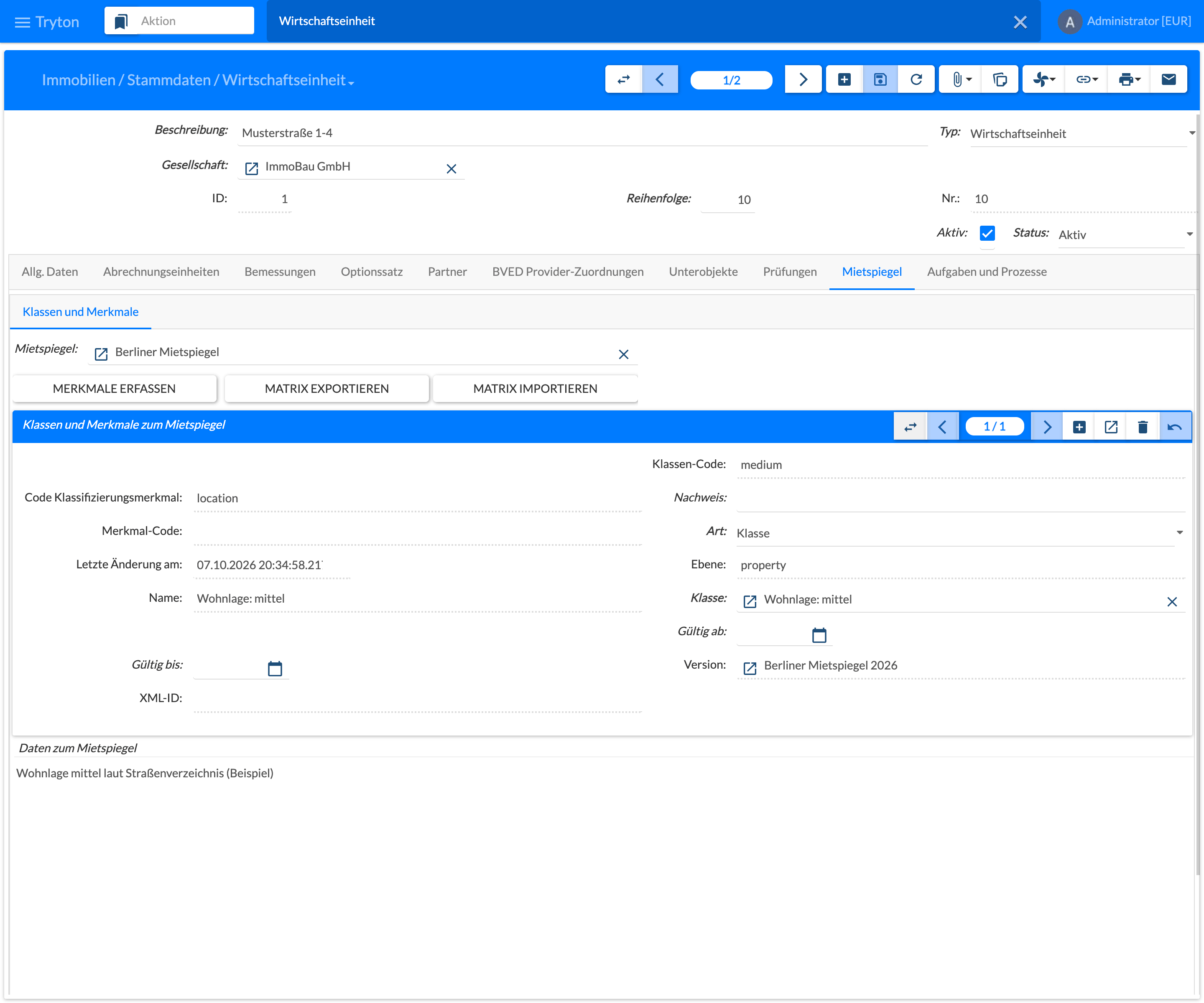
The tab Mietspiegel › Klassen und Merkmale (classes and features) shows the assigned rent survey and the buttons Merkmale erfassen, Matrix exportieren and Matrix importieren at the top, and below the list Klassen und Merkmale zum Mietspiegel. Each entry has the Art (kind: class or feature), the classification attribute or feature, the Klasse (class), Gültig ab / Gültig bis and the Nachweis (evidence); the figure shows the residential location “mittel” (medium) of the property. The field Daten zum Mietspiegel holds remarks and reasons, e.g. the reference in the street directory.
- Assign the rent survey. Only then does the tab also appear on buildings and apartments.
- Classes on property level. In Berlin this is the residential location simple/medium/good, set manually according to the street directory; the evidence is entered under Daten zum Mietspiegel (rent survey data).
- Features of the residential environment (group 5), as far as they are on this level.
- Kappungsgrenze 15 % (Verordnung) (cap 15 % by ordinance) with validity if the state ordinance applies, otherwise 20 %. Also Angespannter Wohnungsmarkt (tight housing market), relevant for the check on new lettings.
- With Matrix exportieren / Matrix importieren (Export / Import Matrix) all buildings and apartments of the property can be maintained in a spreadsheet – one row per object, one column per class or feature.
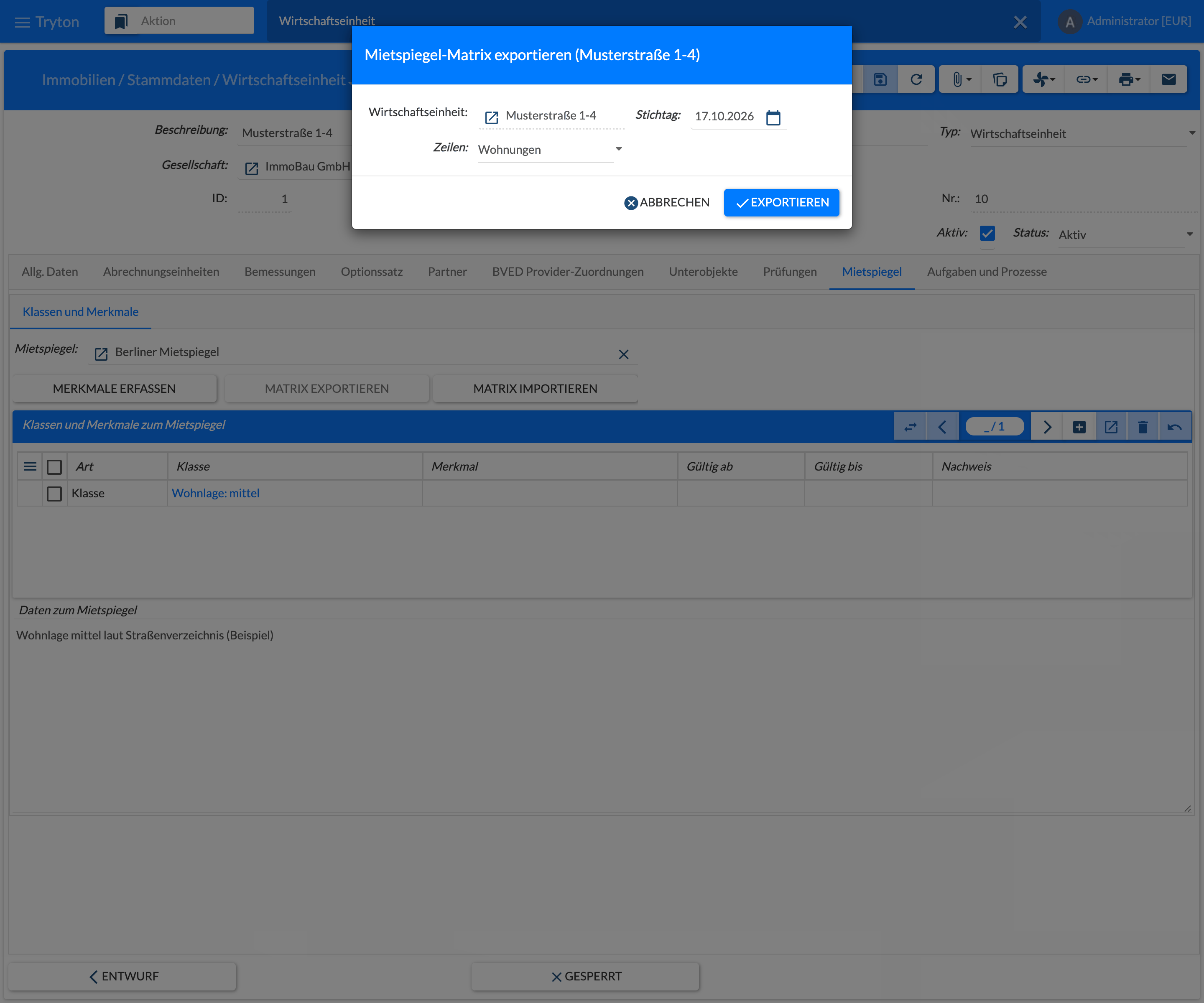
Matrix exportieren asks for Zeilen (rows: apartments or buildings) and Stichtag (key date) and returns a CSV file (separator semicolon): one row per object, one column per classification attribute with the class code and one column per feature of the level, where an “x” marks an assigned feature. The second row starts with “#” and contains the names. This shows all apartments × features at a glance and lets you maintain them in a spreadsheet. Matrix importieren reads the edited file, shows the changes and problems in a Vorschau (preview) and applies them with Übernehmen (Apply) – only if no problems are reported. Valid marks are x, 1, ja/j, yes/y, true/wahr; an empty cell removes the feature.
Building
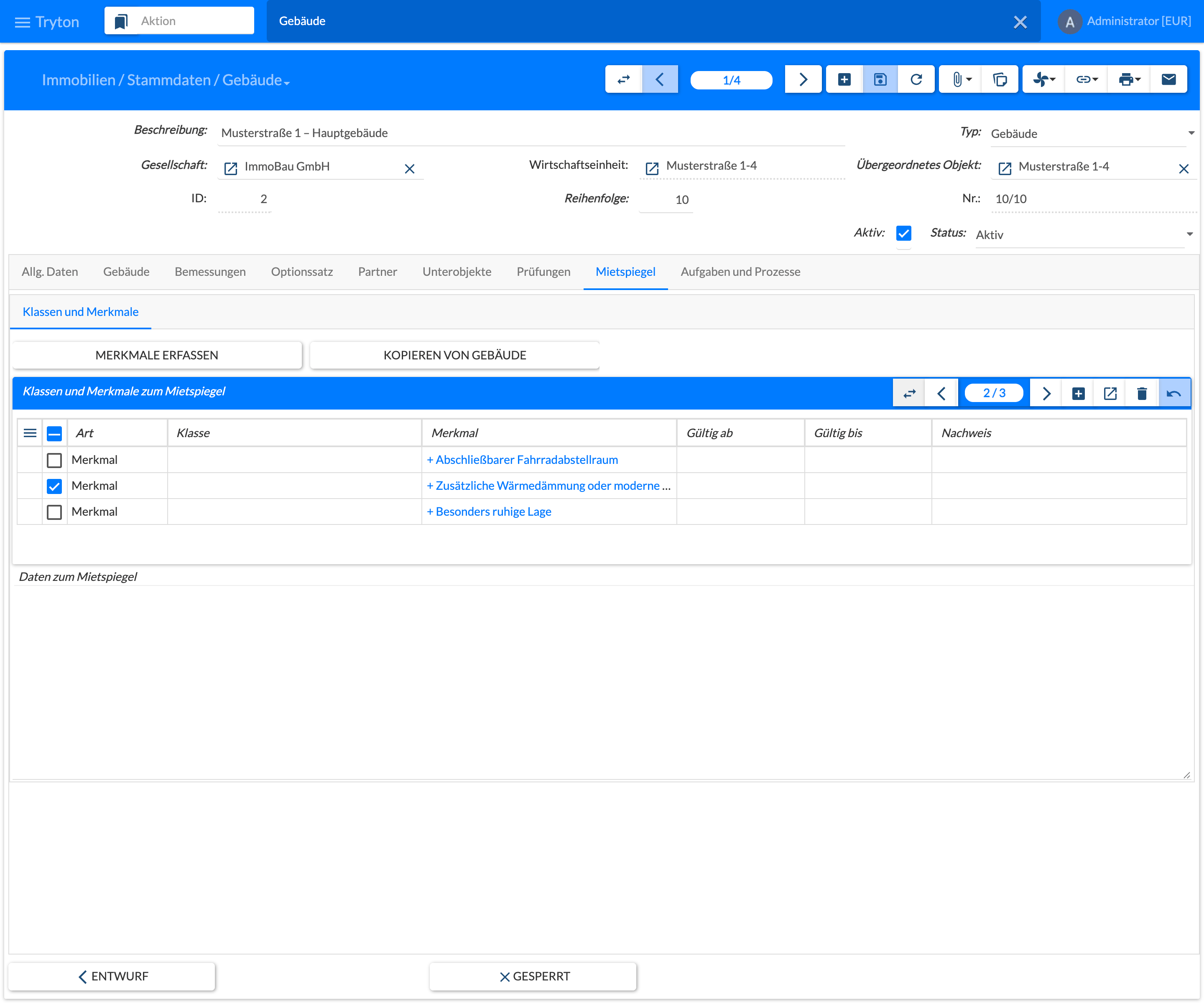
The building has no rent survey field of its own; it comes from the property. The tab shows the buttons Merkmale erfassen and Kopieren von Gebäude, the list of classes and features with kind (+ increasing, − decreasing the residential value), class, feature, valid from/until and evidence, and the field Daten zum Mietspiegel. In the figure three value-increasing features are entered, e.g. a lockable bicycle room and a particularly quiet location.
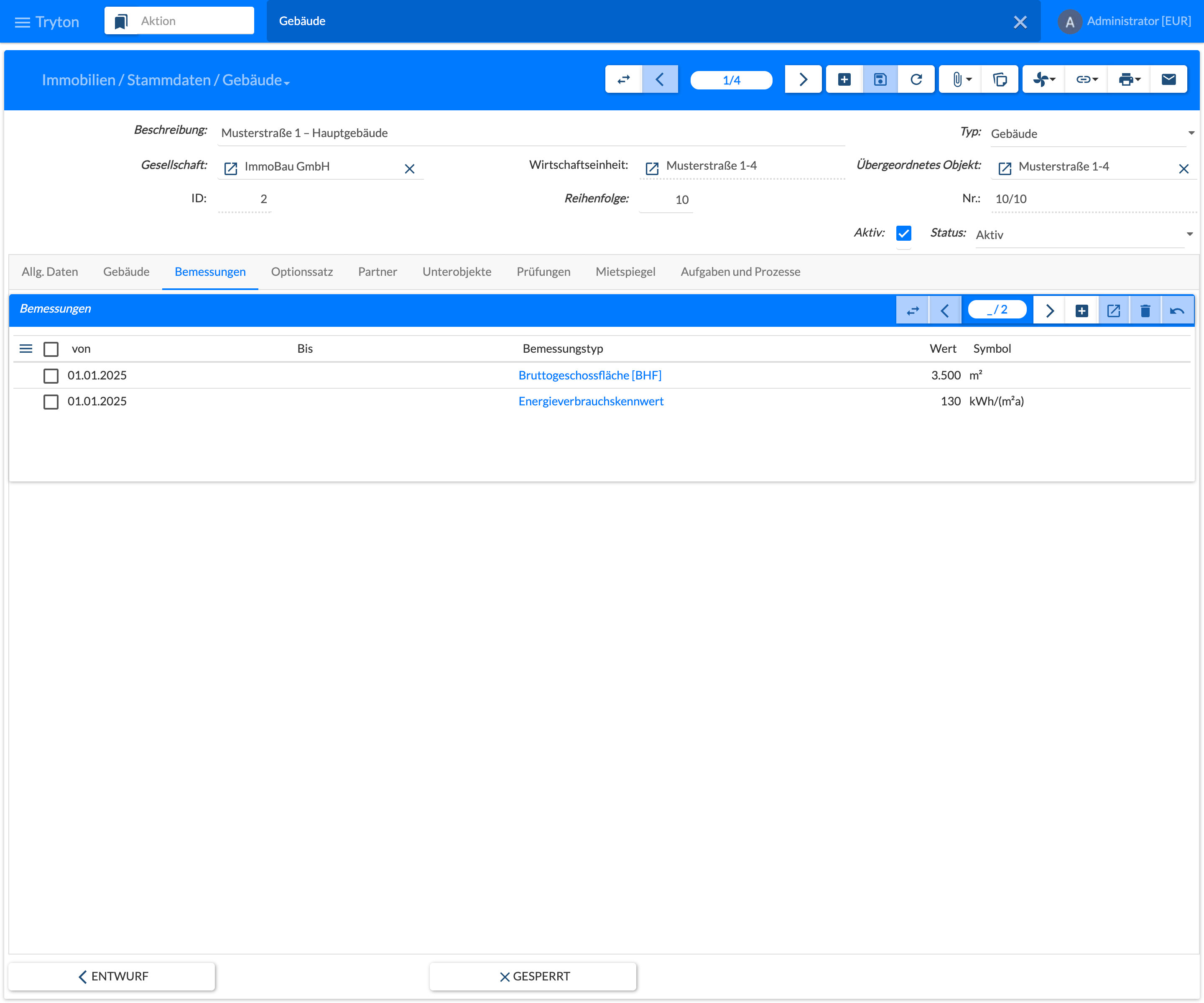
The energy consumption value is entered in the tab Bemessungen (Measurements) of the building with von (valid from), value and unit kWh/(m²a), in the figure next to the gross floor area.
- Year of construction (ready for occupancy): the age class is derived from it, 12 classes in Berlin. Classes depending on the district, e.g. 1973–1990 East/West, are “manual only” and must be assigned.
- Measurement energy consumption value (kWh/(m²a)), already converted. The energy features are set automatically from it; B09 warns if the value is missing.
- Building features (group 4, e.g. elevator, thermal insulation, condition of the staircase) with validity and evidence – quickly via Merkmale erfassen (Assign Features, checklist) or Kopieren von Gebäude (Copy from Building).
Apartment
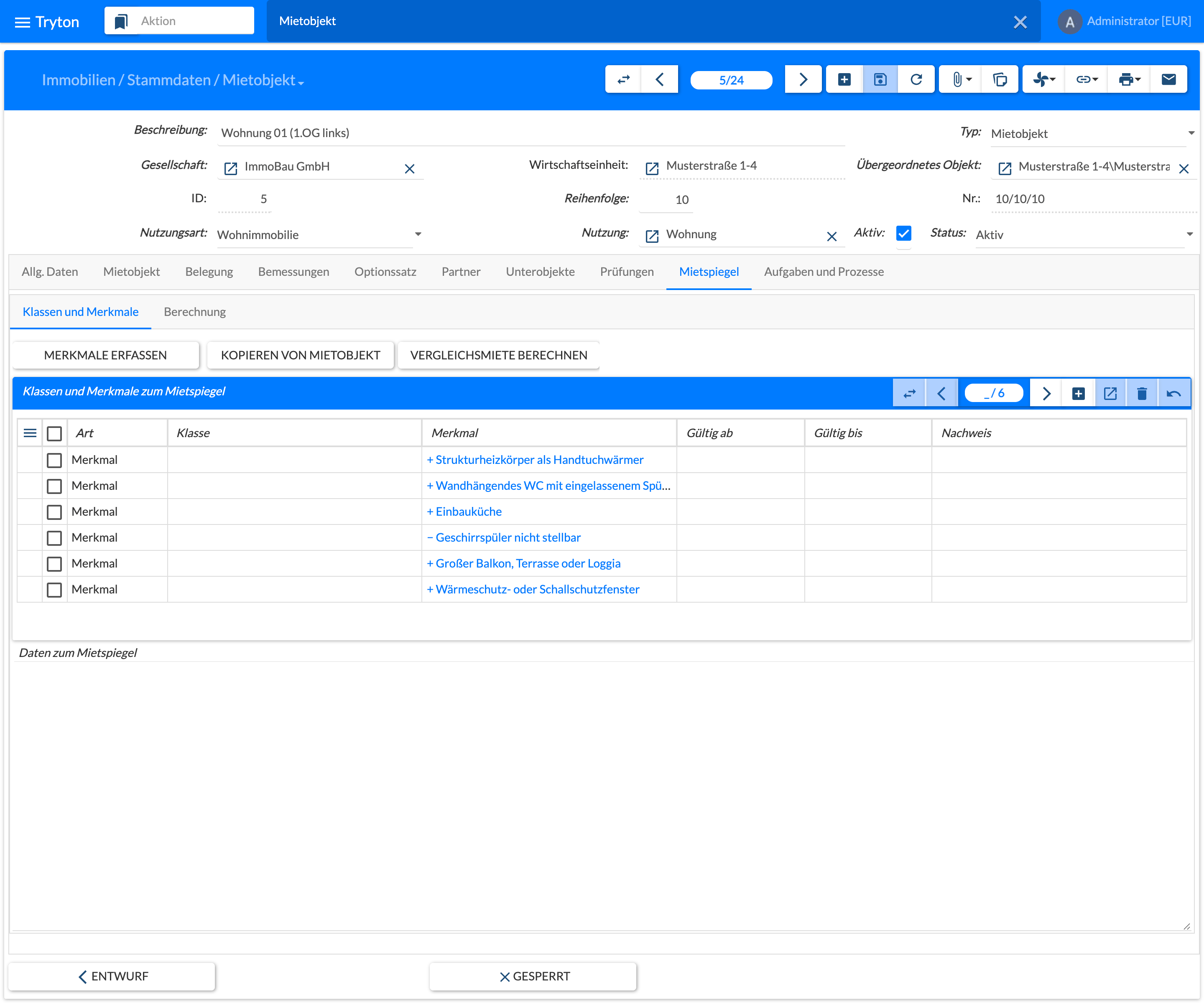
On the apartment the tab Mietspiegel has the sub-tabs Klassen und Merkmale (classes and features) and Berechnung (calculation). Besides Merkmale erfassen there are Kopieren von Mietobjekt and Vergleichsmiete berechnen. In the figure six apartment features are entered, five increasing the residential value (e.g. fitted kitchen, large balcony) and one decreasing it (− no space for a dishwasher).
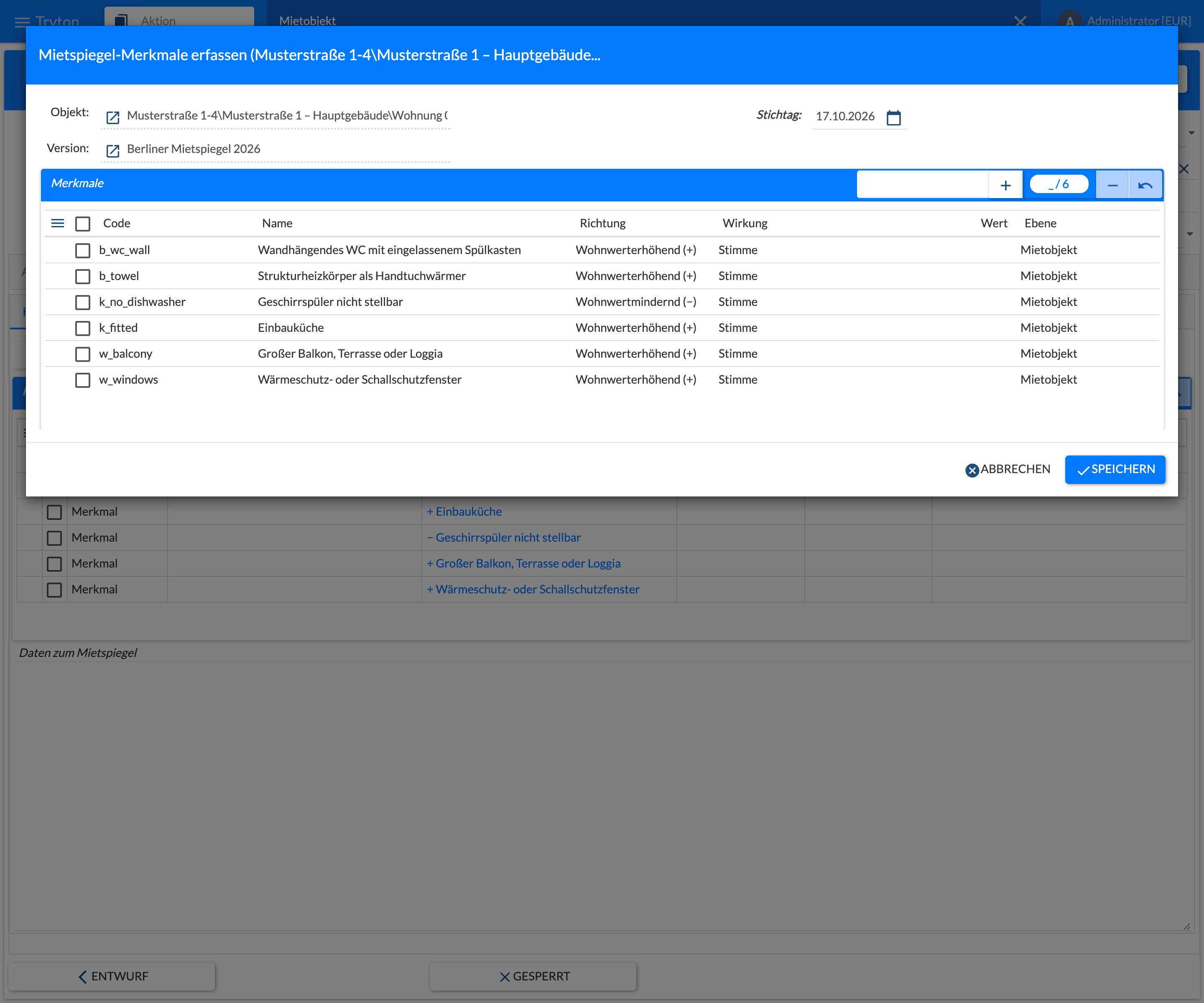
Merkmale erfassen opens the dialog Mietspiegel-Merkmale erfassen (Assign Rent Survey Features) with object, rent survey version and key date. The list shows the features of the object with code, name, direction, effect (vote or value), value and level; + and the search add further features of the level, − removes them. Speichern (Save) takes the list over into the tab. The dialog is the same on buildings and apartments.
- Measurement living area at the key date. It determines the table field (area range) and gives: comparative rent = €/m² × living area.
- Apartment features of the groups bathroom/WC, kitchen and apartment, e.g. fitted kitchen, parquet or bathroom without window – via Merkmale erfassen or Kopieren von Mietobjekt (Copy from Rental Unit), which saves time for identically equipped apartments.
- Vergleichsmiete berechnen (Calculate Comparative Rent; actions on the rental object) shows the result for the apartment directly, without a run.
Rent Survey Calculation
There is exactly one open calculation per apartment and key date, found under Verträge › Mietanpassungen › Mietspiegel-Berechnungen (Comparative Rent Calculations) or in the tab Mietspiegel of the apartment.
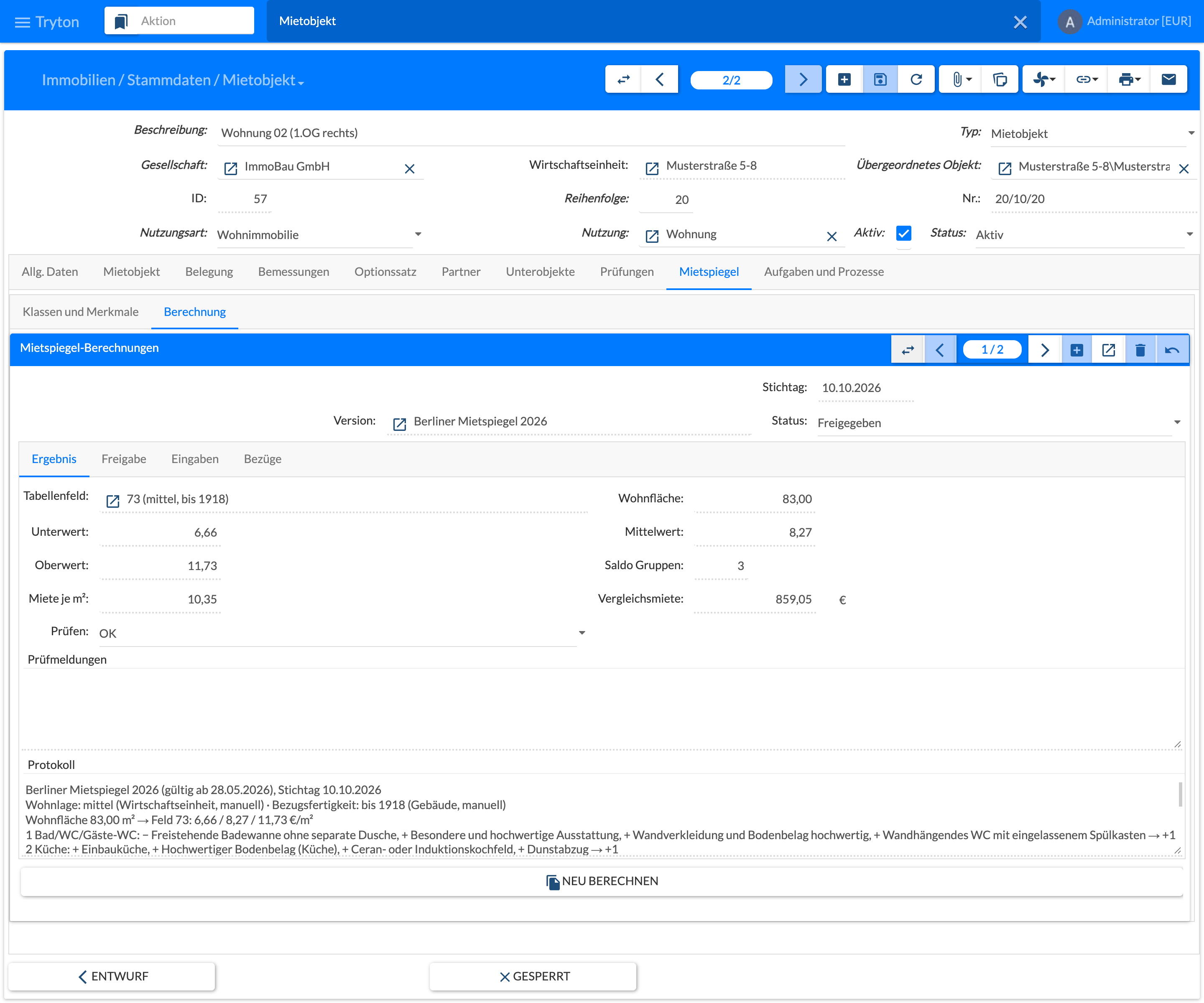
The sub-tab Berechnung (calculation) of the apartment lists the rent survey calculations with key date, version and state. The tab Ergebnis (result) shows table field, lower, middle and upper value, living area, Saldo Gruppen (balance of groups), Miete je m² (rent per m²), Vergleichsmiete and Prüfen (check) with the check messages, below the Protokoll of the classification. Further tabs are Freigabe (acceptance), Eingaben (inputs) and Bezüge (references); Neu berechnen (Recalculate) calculates again. In the figure: field 73 with 6.66 / 8.27 / 11.73 €/m², balance +3, i.e. 8.27 + 3 × 20 % × (11.73 − 8.27) = 10.35 €/m² and 10.35 €/m² × 83.00 m² = 859.05 €.
- Berechnen (Calculate): version at the key date, living area, classes (manual or derived), matching table field, valid and automatic features, then the range classification per group. The result is a protocol with a snapshot of all inputs. Checks:
- B01–B04 are errors (e.g. no class, no or several table fields);
- B05 (outside the qualified range), B06 (mutually exclusive features), B07 and B09 are warnings.
- Freigeben (Accept) is mandatory: the €/m² are taken over, optionally deviating; a warning or a deviating value requires a reason. Accepted calculations are evidence: they cannot be deleted and lock the rent survey version.
Rent Increase by Adjustment Run
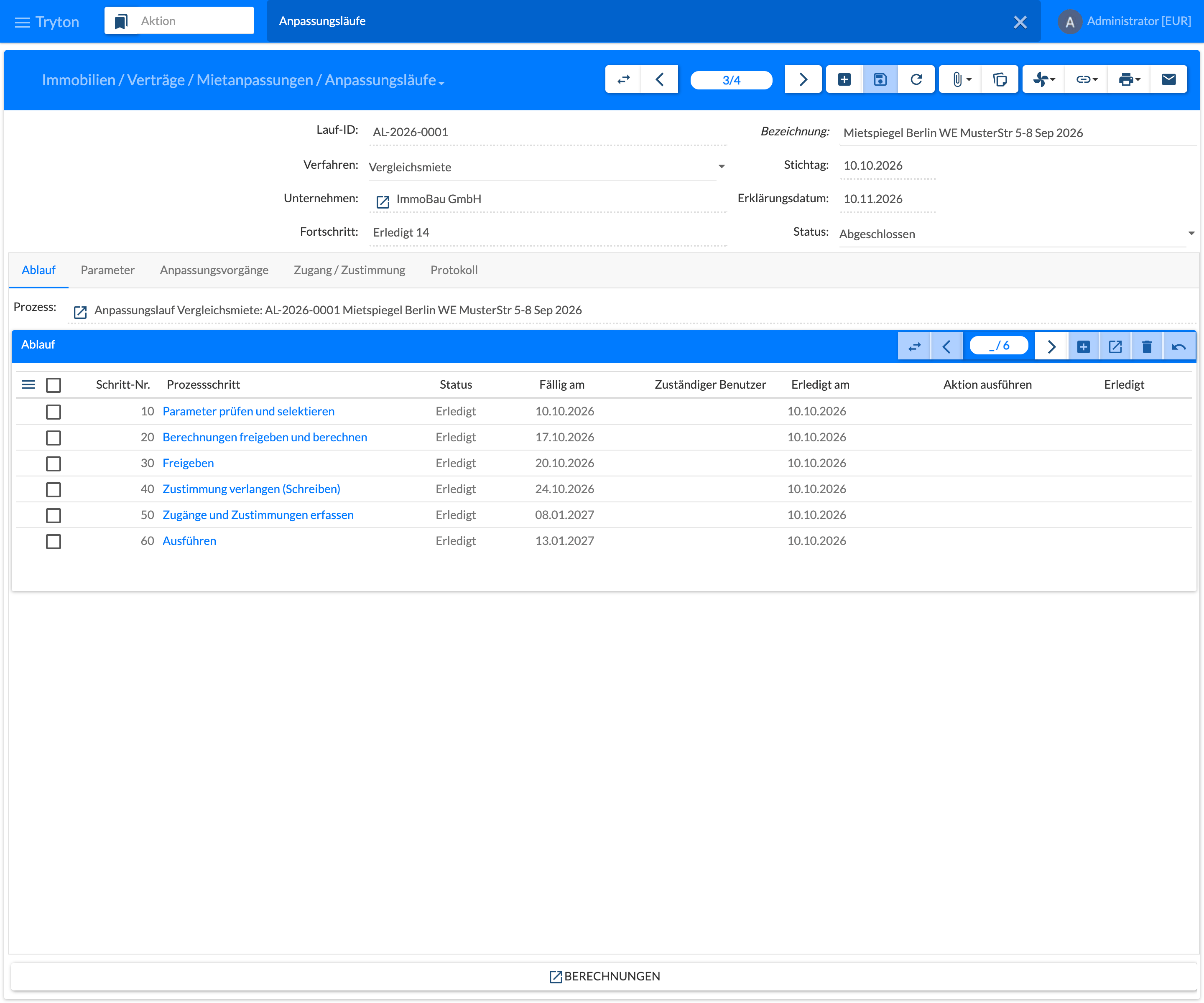
The first selection starts the process Anpassungslauf Vergleichsmiete with six steps: 10 check parameters and select, 20 accept and calculate the calculations, 30 approve, 40 request consent (letters), 50 capture receipts and consents, 60 execute. Each step has a due date and is completed automatically with the state of the run. The button Berechnungen (Calculations) at the bottom opens the rent survey calculations of the run. In the figure the run is Abgeschlossen (closed), all steps are done.
Menu Verträge › Mietanpassungen › Anpassungsläufe, New, procedure Vergleichsmiete:
Parameters:
- company, property, optionally contracts;
- key date and planned declaration date;
- Mindesterhöhung (minimum increase) in € and %;
- Berechnungen anlegen (create calculations, default yes).
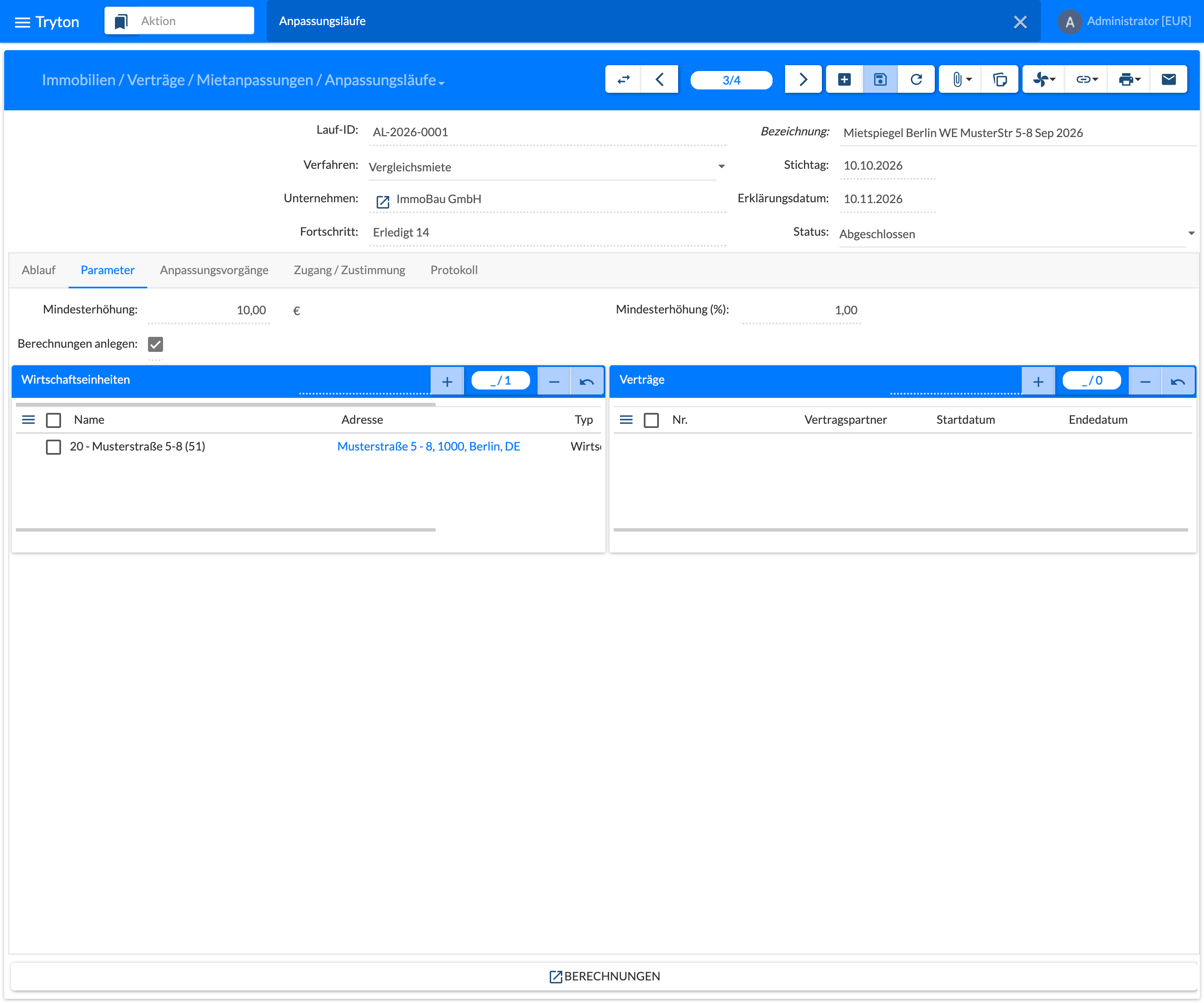
Figure 6.7.3-13: Adjustment run Vergleichsmiete, tab Parameter The tab Parameter holds the minimum increase in € and %, Berechnungen anlegen and the filters Wirtschaftseinheiten (properties) and Verträge (contracts); if the contract list stays empty, all matching contracts of the properties are selected. Key date and declaration date are in the header of the run.
Selektieren (Select): running contracts with a monthly rent term for exactly one apartment are selected. Skipped with a protocol line:
- V01: index rent or running graduated rent;
- V02: open adjustment;
- V03: rent unchanged for less than 15 months – increases due to modernisation or operating costs do not count;
- V04: last request less than 1 year ago;
- V05: not exactly one apartment;
- V06: contract end before the effective date.
For each term an agreement “Vergleichsmiete” is created automatically, and the rent survey calculation is created or recalculated for each apartment.
With the button Berechnungen (Calculations) review and accept the calculations.
Berechnen (Calculate):
- new rent = the lower of comparative rent and cap;
- cap = rent 3 years ago × (1 + 20 % or 15 %) + increases not to be counted;
- effective date = start of the 3rd month after receipt.
Checks V07–V12, e.g. “cap applies” (note), “no increase / below minimum increase” (error), “posted beyond the effective date” (warning). A manual amount with a reason is possible.
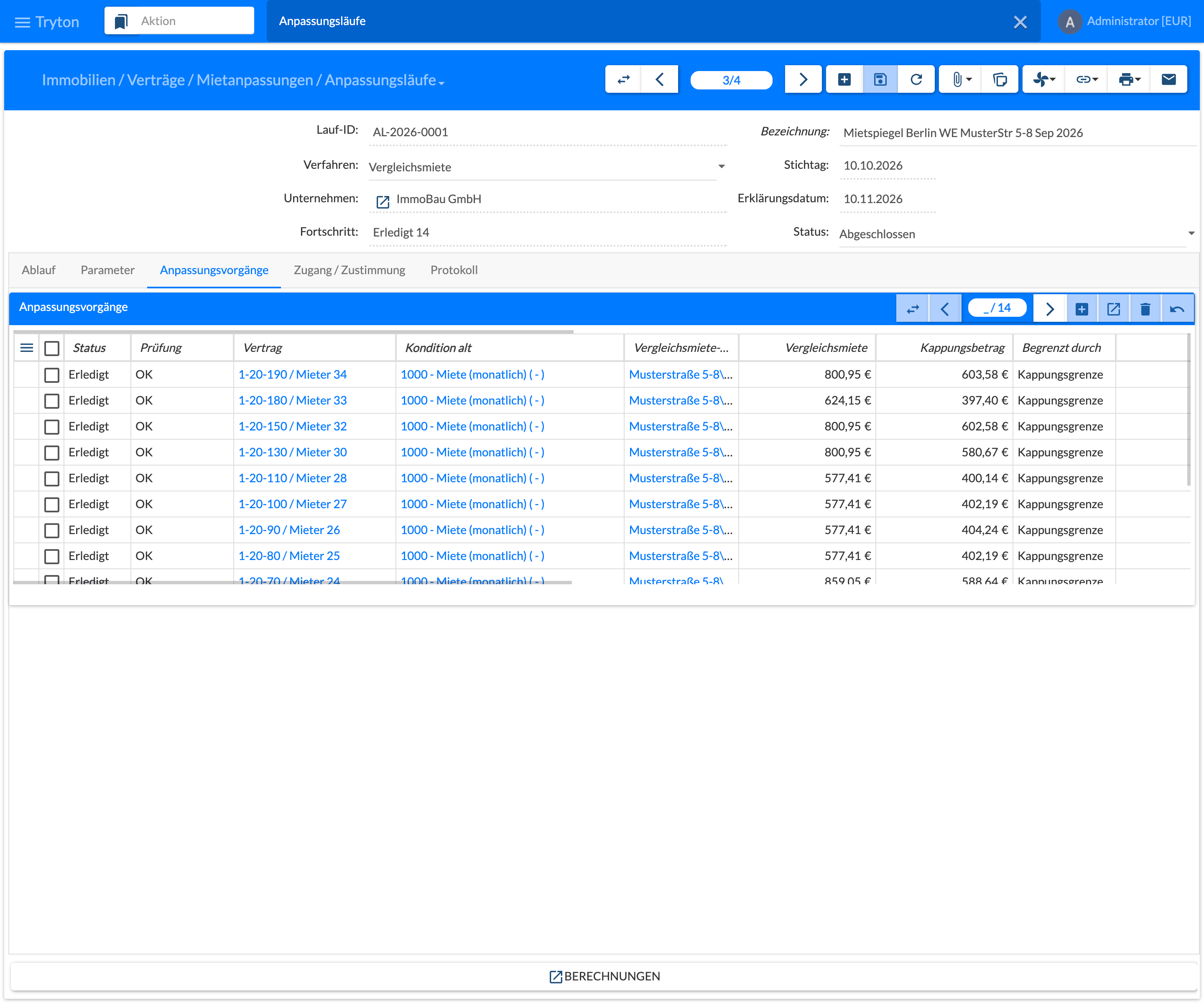
Figure 6.7.3-14: Adjustment run Vergleichsmiete, tab Anpassungsvorgänge The tab Anpassungsvorgänge (adjustments) shows per contract the state, check, contract, Kondition alt (old term), the rent survey calculation, the Vergleichsmiete (comparative rent), the Kappungsbetrag (cap limit: highest rent allowed by the cap) and Begrenzt durch (limited by) – comparative rent or cap. In the figure the cap limits the increase for all adjustments.
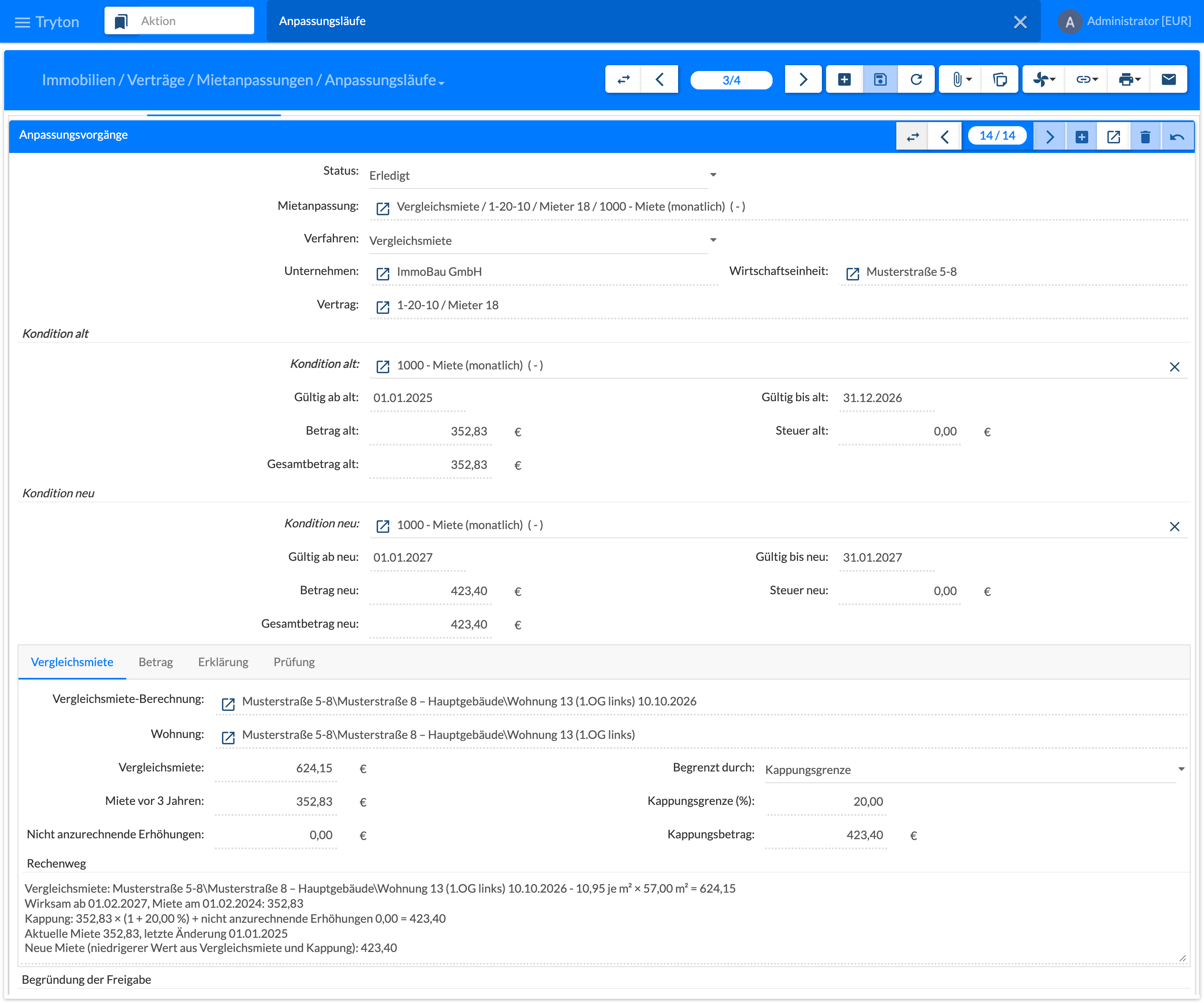
Figure 6.7.3-15: Adjustment, tab Vergleichsmiete A double click opens the adjustment with Kondition alt and Kondition neu (old and new term) and the tabs Vergleichsmiete, Betrag (amount), Erklärung (declaration) and Prüfung (check). The tab Vergleichsmiete shows the rent survey calculation and the apartment, comparative rent, Miete vor 3 Jahren (rent 3 years ago), Nicht anzurechnende Erhöhungen (increases not counted), Kappungsgrenze (%) (cap), Kappungsbetrag and Begrenzt durch. The Rechenweg (calculation) makes the result traceable, in the figure:
- comparative rent 10.95 €/m² × 57.00 m² = 624.15 €;
- cap 352.83 € × (1 + 20 %) + 0.00 € = 423.40 €;
- new rent = the lower value, i.e. 423.40 €.
Below is the Begründung der Freigabe (approval reason).
Freigeben (Approve), optionally Probeschreiben (Sample Letter), then Ankündigen (Announce). The rent increase request (report
comparative_rent_letter_de.odt) contains:- current and new net rent and the effective date;
- the justification: rent survey, version, table field with range, classification according to the protocol, if applicable the deviating accepted rent with reason;
- cap, period for consideration and a consent form.
The original is archived.
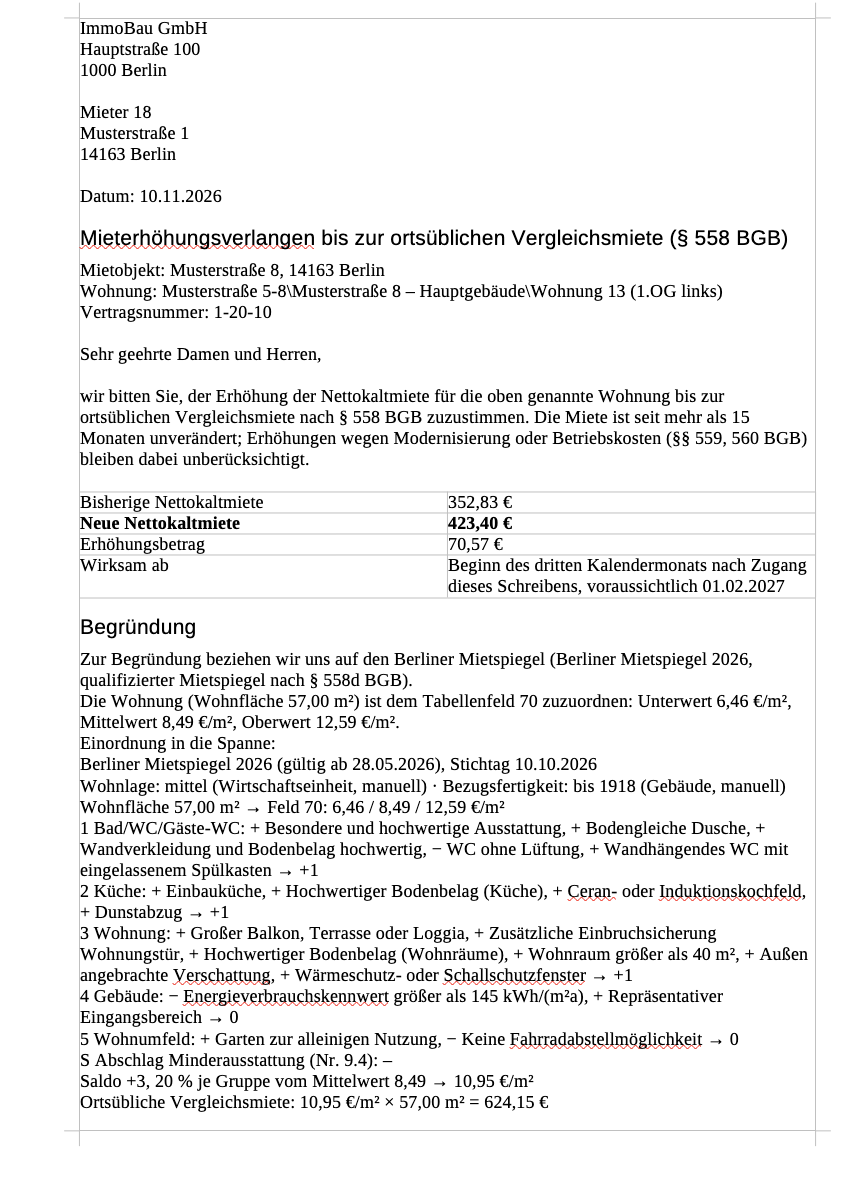
Figure 6.7.3-16: Rent increase request, page 1 The example shows the first page: current and new net rent, increase amount and “Wirksam ab” (start of the third calendar month after receipt, expected date calculated from the planned declaration date). The Begründung (justification) names rent survey and version, the table field with lower, middle and upper value and the classification within the range: residential location and year of construction, per feature group the features with + / − and the result of the group (+1, 0, −1), the balance (in the example +3; starting from the middle value 8.49 €/m², 20 % of the range up to the upper value per group, i.e. 8.49 + 3 × 20 % × 4.10 = 10.95 €/m²) and from it the local comparative rent 10.95 €/m² × 57.00 m² = 624.15 €. The new rent is limited by the cap to 423.40 €.
In the tab Zugang / Zustimmung (Receipts / Consents):
- Receipt date: the consent period is calculated from it (end of the 2nd month after receipt), and a task is created.
- Consent: consented / partially (with amount) / refused, with date. The period for legal action ends 3 months after the consent period.
When all decisions are entered, the run is Bereit zur Ausführung (ready).
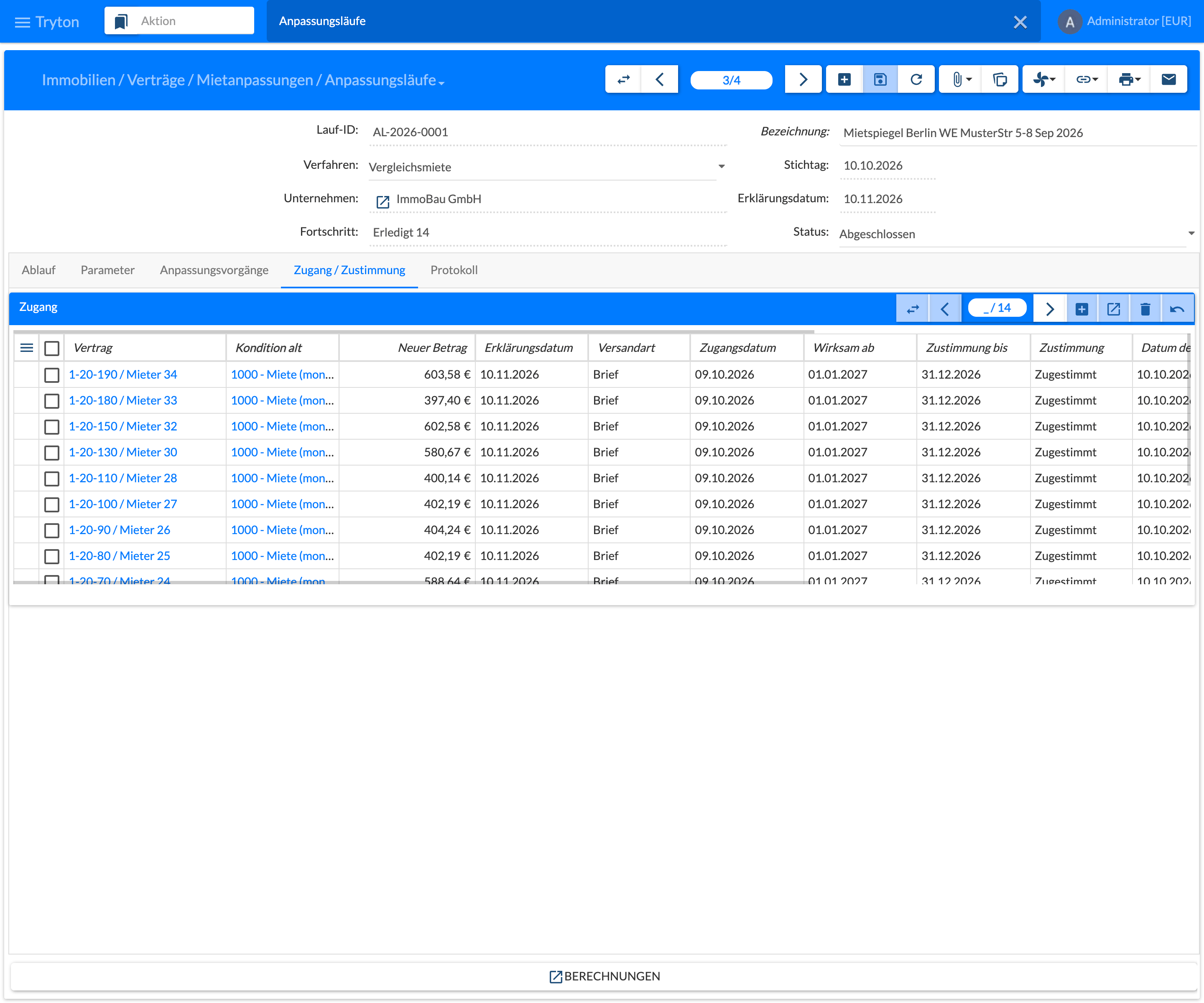
Figure 6.7.3-17: Adjustment run Vergleichsmiete, tab Zugang / Zustimmung The list Zugang (receipts) shows per contract the old term, Neuer Betrag (new amount), Erklärungsdatum (declaration date), Versandart (dispatch method), Zugangsdatum (receipt date), the resulting Wirksam ab (effective from) and Zustimmung bis (consent until), and Zustimmung (consent) with its date. In the figure: receipt in October, so consent until 31 December and effective from 1 January of the following year.
Ausführen (Execute):
- Consent: the term is split at the effective date with the requested or consented amount.
- Refusal: the adjustment gets the state Abgelehnt (refused), and the task Zustimmungsklage prüfen (check action for consent) is created. The lawsuit itself is not part of the module.
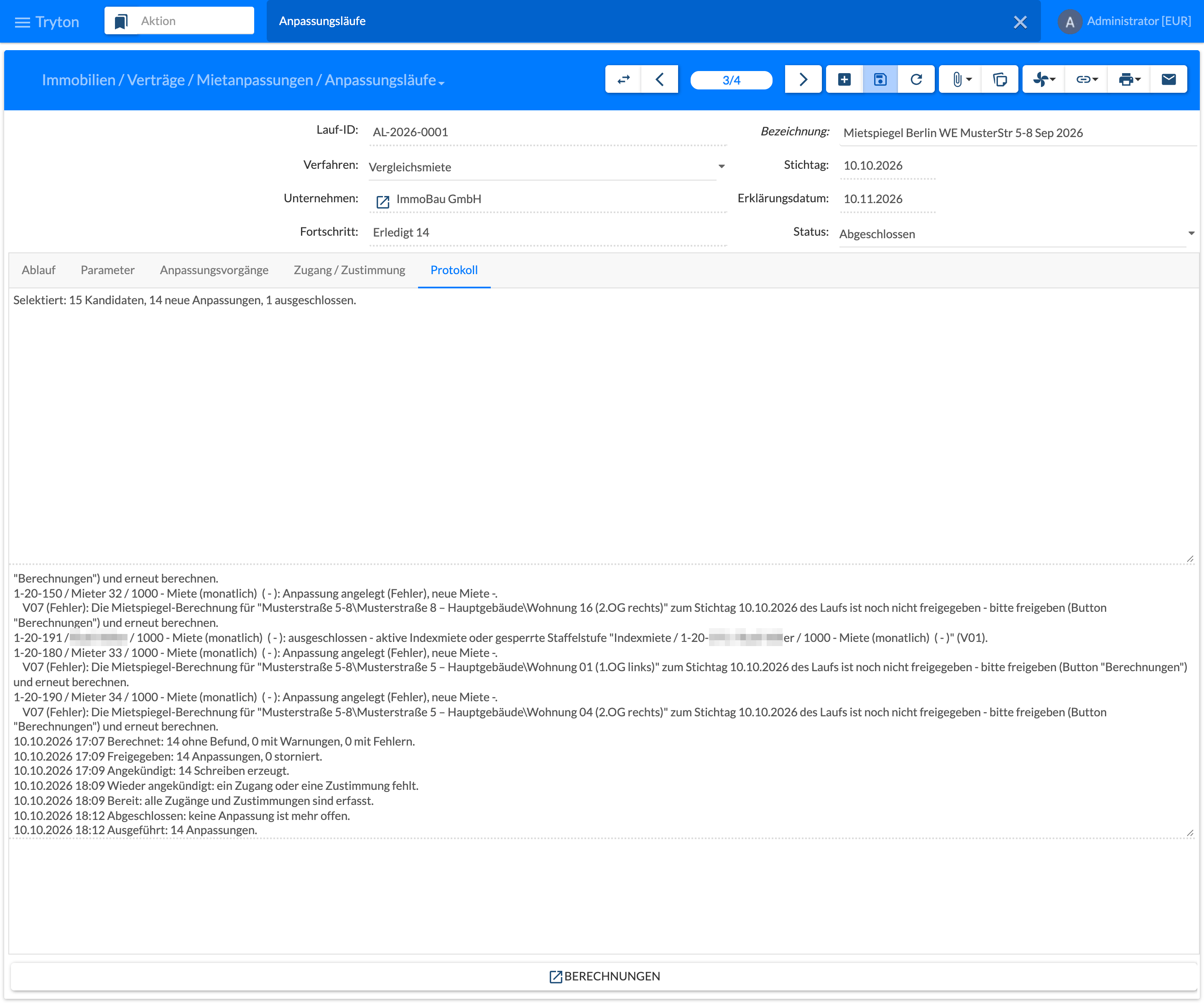
The tab Protokoll (protocol) shows the summary of the selection at the top (in the figure 15 candidates, 14 new adjustments, 1 excluded) and below the running protocol:
- per candidate the result with the findings, e.g. V01 (excluded because of an active index rent) or V07 (rent survey calculation not yet accepted – accept it via Berechnungen and calculate again);
- per step a line with time stamp: calculated, approved, announced, ready, executed, closed.
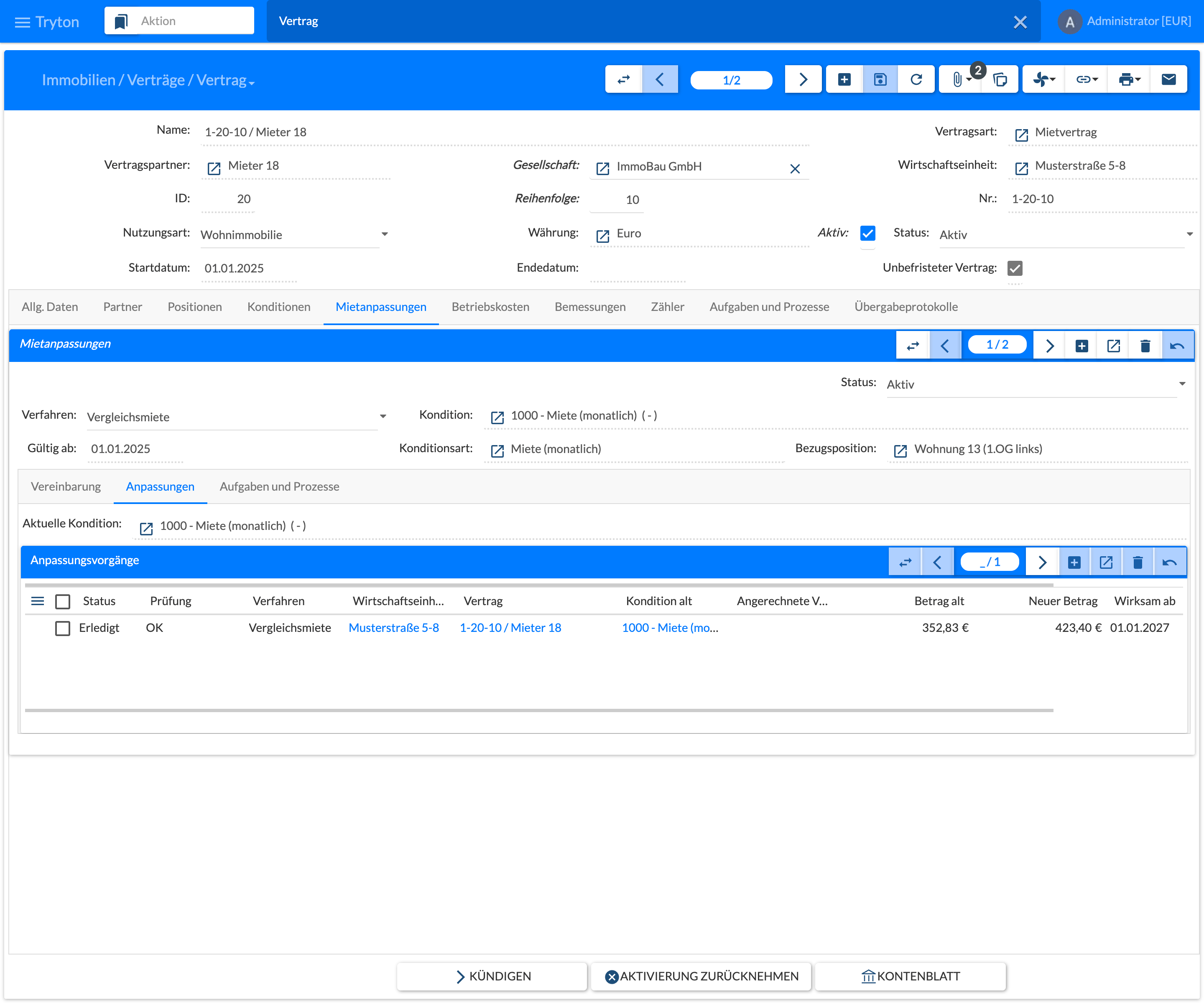
On the contract the comparative rent appears in the tab Mietanpassungen as a rent adjustment of its own with procedure Vergleichsmiete, term, term type and reference item (apartment). It is created automatically at selection. The sub-tab Anpassungen (adjustments) shows the Aktuelle Kondition (current term) and all adjustments with state, check, old amount, new amount and Wirksam ab (effective from) – in the figure the executed increase from 352.83 € to 423.40 € from 01.01.2027.
Legal Framework
| Rule | Implementation in the module |
|---|---|
| Rent unchanged for 15 months, request at the earliest 1 year after the last increase (§ 558 para. 1) | V03 / V04; modernisation and operating costs excluded. |
| At most up to the local comparative rent | Accepted rent survey calculation (V07). |
| Cap 20 % or 15 % in 3 years (§ 558 para. 3) | Automatic; 15 % via the flag on the property. |
| Justification in text form, here rent survey (§ 558a) | Letter with table field, range and classification; only this means of justification. |
| Consent by the end of the 2nd month after receipt, legal action within 3 further months (§ 558b) | Periods calculated, tasks created. |
| Effective from the start of the 3rd month after receipt (§ 558b para. 1) | Effective date from the receipt. |
| Excluded for index or graduated rent (§§ 557a, 557b) | V01, locks. |
| Residential space only | Via the type of use. |
| New letting: rent cap +10 % (§ 556d), otherwise +20 % as orientation (§ 5 WiStG) | Wizard Prüfung Vergleichsmiete Neuvermietung on the draft contract, incl. modernisation amount (§ 556e para. 2) and exception for comprehensive modernisation (§ 556f). |
Not implemented or the user’s responsibility
- Expert opinions or comparable apartments as justification.
- The deduction of third-party funds (§ 558 para. 5) is open.
- The classification itself (residential location, features) is the landlord’s responsibility.
- The rent survey data must be checked against the official original before productive use.
- The letter template has not yet been legally reviewed.
6.7.4 Modernisation
After a modernisation the landlord may increase the annual rent by a share of the costs (§§ 555b–555f, 559–559e BGB). Unlike index and comparative rent, the starting point is not a single term but a measure on buildings of a property whose costs are allocated to several rental units. The modernisation therefore has two phases:
- the measure – planning, announcement, work, costs;
- the rent increase by adjustment run – increase declaration and split of the rent term.
A process with tasks and deadlines accompanies both phases.
Prerequisites (once)
Modernisation rule under Immobilien › Einstellungen › Modernisierungsregeln (Real Estate › Configuration › Modernisation Rules; group real estate administration only). The statutory values as of 01.01.2024 are shipped:
- rate 8 %, heating 10 %;
- simplified procedure up to 10,000 € per apartment, with a maintenance flat rate of 30 % (heating 15 %) and a lock of 5 years;
- cap 3.00 €/m², or 2.00 €/m² for a rent below 7.00 €/m², within 6 years; heating additionally 0.50 €/m²;
- announcement period 3 months, extension 6 months, tolerance 10 %.
The rule valid on the announcement date applies (otherwise on the planned start).
Set the cap measurementSet the Kappungs-Bemessung (cap measurement) once in the rule, e.g. living area. It provides the area for the cap and the increase per m² in the letter. Without it Ankündigen (Announce) is not possible (M02).
Allow the procedure: modernisation on the contract type and on the term type of the rent, see 2.5.4 Contracts. Only such a term becomes the rent term of an apartment.
Maintain measurements: the measurement for the allocation key on the apartments, usually living area.
For the planning calculation (optional): rent survey on the property and classification of the objects, see 6.7.3 Comparative Rent.
Create and Plan the Measure
Menu Verträge › Mietanpassungen › Modernisierungen (Modernisations) with the tabs Planning, In Progress, Completed, Settled and All; New creates a measure (number MOD-year-no.). The process Modernisierung starts automatically and is shown in the tab Ablauf (workflow).
Tab Maßnahme (measure):
- name, company, property, buildings (empty = all buildings of the property);
- measure types according to § 555b BGB: no. 1 energetic, 1a heating system, 2 primary energy/climate protection, 3 water, 4 utility value, 4a fibre optics, 5 living conditions, 6 not attributable to the landlord, 7 new living space – nos. 2 and 7 alone do not allow an increase;
- variant: Standard (§ 559, 8 %), Simplified (§ 559c) or Heating system (§ 559e, 10 %);
- description and energy saving (flat values allowed);
- flags Bagatelle (trivial measure, § 555c para. 4, with reason), Leerstand (vacancy), Umfassende Modernisierung (comprehensive modernisation, § 556f, with reason), Nicht vom Vermieter zu vertreten (not attributable to the landlord) and JAZ Wärmepumpe nachgewiesen (heat pump SPF proven).
Tab Termine (schedule): planned start and duration, later actual start and end.
Tab Kosten (costs):
- cost lines per trade, not per invoice, e.g. facade, windows, heating: kind planned, later actual; net, tax, gross; measure type; maintenance share (none, percent or net amount – only for the standard variant, otherwise the flat rate applies) and optionally a single rental unit, e.g. for a balcony.
- Expected costs and expected operating costs; both belong in the announcement.
Tab Drittmittel (third-party funds, § 559a): a grant or third-party payment reduces the costs, the interest advantage of a loan reduces the annual amount; optionally for a single rental unit.
Allocation key: equal shares, measurement (default, with a selectable measurement type, e.g. living area or number of windows) or manual (quantity per rental unit, reason required). The share is quantity / total of the participating units.
Mietobjekte ermitteln (Determine Rental Units): the module takes over the apartments of the buildings with contract, rent term and quantity; running it again updates them and keeps manual settings. In the tab Mietobjekte you can correct per rental unit:
- In Verteilung (in allocation): deselect only with a reason – the share of the others increases; a vacant unit always takes part, its share is borne by the owner (M09);
- Vorsteuerabzug (input tax deduction): costs net instead of gross; proposed if a term of the contract carries VAT;
- Keine Erhöhung (no increase) with a reason (vacancy, commercial, graduated/index rent, hardship accepted, termination, waiver …): the unit stays in the allocation but gets no increase and no letter. Vacancy and commercial are set automatically.
Per rental unit you see share, allocable costs and the expected increase per month after the cap.
Planning calculation (optional, tab Kalkulation, in planning and draft): enter planned features per building and apartment – rent survey classes or features (add/remove) and measurements after the modernisation, e.g. the new energy consumption value. Kalkulieren (Calculate) shows per apartment:
- increase according to § 559 and the rent afterwards;
- comparative rent before and after, the rent according to § 558 and from when it can be requested;
- limit for a new letting;
- additional rent p. a. and yield.
This lets you decide whether the cost allocation according to § 559 or a later comparative rent in the modernised state (§ 558) yields more.
Planung übernehmen (Take Over Planning): state planning → draft.
Calculation of the Allocation
- Share per participating rental unit by the key; costs and funds of a single unit go to that unit only.
- Cost basis net or gross (input tax deduction).
- Allocable costs = costs − maintenance share (percent, amount or flat rate 30 % / 15 %) − grants and third-party payments.
- Annual amount = allocable costs × 8 % or 10 % − interest advantage; monthly amount = annual amount / 12.
- Cap: area × 3.00 €/m² (2.00 €/m² for a rent below 7.00 €/m²), heating additionally area × 0.50 €/m²; previous increases within the last 6 years are taken into account by the adjustment run.
Example: building with 420 m², costs 180,000 €, maintenance share 25 %, grant 15,000 € → allocable 120,000 €; an apartment with 64.20 m² bears 18,342.86 € × 8 % = 1,467.43 € per year, i.e. 122.29 € per month.
Announcement (§ 555c BGB)
Optionally Probeschreiben (Sample Letter): the announcement of the first rental unit marked ENTWURF, not archived.
Ankündigen (Announce). The module checks:
- M01: at least one measure type allowing an increase;
- M02: required details – description, planned start and duration, expected costs and operating costs, cap measurement;
- M03: start at the earliest 3 months after the announcement;
- M04: heating only with no. 1a;
- M05: limit of the simplified procedure (warning);
- M10: quantities for the key measurement or manual.
Then a letter to all main tenants is created per rental unit with an increase (report Modernisierungsankündigung) with kind and scope, energy saving, start and duration, the expected increase per month and per m², the future operating costs, the note on the hardship objection with form and deadline (§ 555d) and the special termination right (§ 555e). The letters are archived on the rental unit and on the contract; the announced increase is frozen.
Zugang erfassen (Capture Receipts), for all units at once or per unit. From this the module calculates the deadlines Härteeinwand bis (hardship objection until) and Sonderkündigung bis (special termination until): end of the month after receipt. On the rental unit you also enter Ankündigung mangelhaft (announcement defective), Härtehinweis fehlt (hardship notice missing; then no hardship deadline), the hardship objection with date, note and decision, and Gekündigt (terminated).
Exceptions: trivial measures (§ 555c para. 4) and vacancy are not announced – the work starts directly.
Execution of the Work
- Arbeiten beginnen (Start Work). M06 warns if the start is less than 3 months after the receipt of the announcement.
- During the work enter the actual costs, preferably with reference to the supplier invoice line; net amount and tax are taken over. The measure is then visible and searchable on the invoice line.
- Fertigstellen (Complete). M07 checks that costs exist and, for the standard variant, that every line has a maintenance share. From then on the tab Prüfmeldungen (check messages) shows M08: the input tax of the rental units compared with the option rate of the property (§ 15a UStG, consult a tax advisor); without a deviation it says “Keine Meldungen.”
- When using the rent survey, Geplante Merkmale übernehmen (Apply Planned Features): the planned classes, features and measurements apply to the objects from the completion (process step 90).
A vacancy measure is settled immediately on completion.
Rent Increase (§§ 559, 559b BGB)
In the completed measure click Anpassungslauf anlegen (Create Adjustment Run). The run opens with the measure as parameter; key date and declaration date are today, at the earliest the completion.
Selektieren (Select): one adjustment per rental unit. Skipped with a reason in the protocol: no increase, no contract or rent term, already an adjustment for the unit, procedure not allowed.
Berechnen (Calculate):
- increase = allocable costs × 8 % / 10 %, minus interest advantage; the actual costs are used, as long as there are none the planned costs;
- cap with the previous increases of the apartment within the last 6 years (heating separately);
- effective from the start of the 3rd month after receipt, + 6 months without announcement or its receipt, with a defective announcement or more than 10 % above the announced increase.
The values are shown on the adjustment in the tab Modernisierung. Checks E01–E14, e.g. graduated rent (E02), index rent only for circumstances not attributable to the landlord (E03), hardship objection open (E04), cap applies (E05), postponed by 6 months (E07), no cap area (E10), termination (E11), declaration before completion (E12).
Freigeben (Approve), optionally Probeschreiben, then Ankündigen. The increase declaration (report Modernisierungs-Mieterhöhung) contains the reference to the announcement, costs per trade, maintenance share, third-party funds, key and share, allocable costs, annual and monthly amount, old and new rent, effective date, cap or extension and the special termination right according to § 561. Schreiben drucken (Print Letters) prints all letters still to be sent.
In the tab Zugang / Zustimmung capture the receipt; the module calculates Sonderkündigung bis (end of the second month after receipt, § 561). The tenant’s consent is not required; the increase is a unilateral declaration. If the tenant has terminated according to § 561, set Gekündigt and cancel the adjustment.
Ausführen (Execute, in the background): the term is split at the effective date with the new rent; errors are written to the protocol. When the run is closed, the measure changes to Abgerechnet (settled).
The rental unit of the measure then shows the adjustment and the state of the increase.
Process and Deadlines
| No. | Process step | Completed by |
|---|---|---|
| 10 | Plan and calculate (optional) | state draft |
| 20 | Determine rental units | rental units exist |
| 30 | Announce the measure | state announced; not for vacancy and trivial measures |
| 40 | Capture receipts of the announcement | receipt at every unit with an increase |
| 50 | Handle hardship objections and special terminations | deadlines expired, no objection open |
| 60 | Start the work | state in progress |
| 70 | Complete the work, determine the costs | state completed |
| 80 | Start the adjustment run | measure settled; not for vacancy |
| 90 | Update rent survey features | manual; only with a rent survey |
Deadline tasks: hardship objection (per rental unit), start of work and increase declaration (on the measure) and special termination according to § 561 (on the adjustment), see 2.5.7 Tasks and Processes. The adjustment run has its own process Anpassungslauf Modernisierung.
Further Support
- Vacancy: in the process Leerstand / Neuvermietung (vacancy / new letting) of the rental unit the optional step Modernisierung planen creates a vacancy measure (wizard Modernisierung planen (Leerstand)), see 5.3 Rental Objects. It is carried out without announcement and settled on completion. Its amount counts for the next letting.
- New letting: the wizard Prüfung Vergleichsmiete Neuvermietung raises the limit of the rent cap by the modernisation amount of the last 3 years (§ 556e para. 2). After a comprehensive modernisation there is no limit for the first letting (§ 556f).
Not covered
- Commercial leases – there only the contract applies, possibly with a free adjustment.
- The legal review of the letter templates.
- For heating systems with a heat pump the 50 % rule must be checked manually (E08).